
Conversations around data and AI in enterprises these days are no longer about if they should adopt these, but how they should do so responsibly, effectively, and at scale. Data is abundant. AI is powerful. Yet, despite massive investments, many organizations struggle to translate insights into outcomes.
This is because data and AI alone are not enough.
True transformation happens at the point where data, AI, and human judgment converge, where machine intelligence amplifies human decision-making instead of replacing it. This convergence is where businesses move from automation to augmentation, from predictions to purposeful action.
We believe this intersection is the foundation of sustainable, intelligent enterprises.
The Three Forces Shaping Modern Decision-Making
Before understanding the convergence, let’s break down the three forces at play.
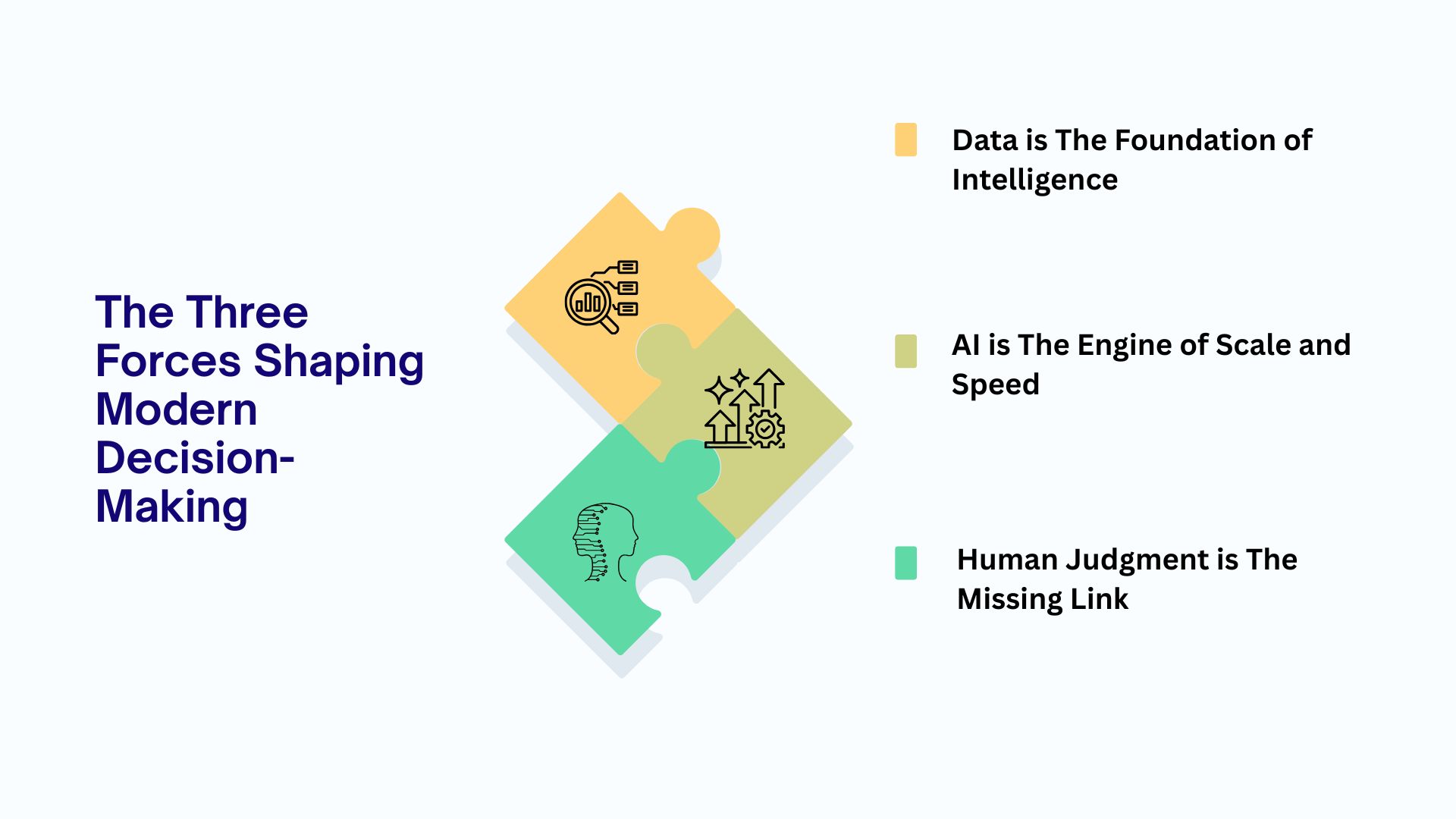
- Data is The Foundation of Intelligence
Data is the raw material of modern enterprises. Every transaction, interaction, sensor, click, and process generates data. However, data by itself is inert.
Most organizations today face common challenges as follows-
- Data exists in silos across departments
- Inconsistent data quality and governance
- Lack of context around metrics
- Overwhelming dashboards with limited actionability
Without the right structure, architecture, and governance, data becomes noise instead of insight.
Data must be trusted, contextual, and aligned with business objectives to be useful.
- AI is The Engine of Scale and Speed
AI brings speed, pattern recognition, and scalability that humans simply cannot match. From forecasting demand and detecting fraud to optimizing supply chains and personalizing customer experiences, AI excels at the following-
- Processing massive volumes of data
- Identifying hidden patterns
- Generating predictions and recommendations
- Automating repetitive decisions
However, AI systems are only as good as the data they are trained on, the assumptions embedded in their models, and the objectives they are designed to optimize. Left unchecked, AI can confidently make the wrong decisions and that too faster.
This is where many AI initiatives fail- they optimize algorithms without aligning them to human values, ethics, or real-world complexity.
- Human Judgment is The Missing Link
Human judgment brings what machines cannot- context and nuance, ethical reasoning, empathy and emotional intelligence, strategic thinking and long-term vision, and accountability for outcomes.
Humans understand why a decision matters, not just what decision to make.
Yet, relying only on human intuition in a data-rich, fast-moving environment leads to cognitive bias, slower decisions, inconsistent outcomes, and limited scalability.
The goal, therefore, is not to choose between humans and AI, but to design systems where humans and AI work together.
The Power of Convergence
When data, AI, and human judgment converge, organizations unlock a new level of intelligence.
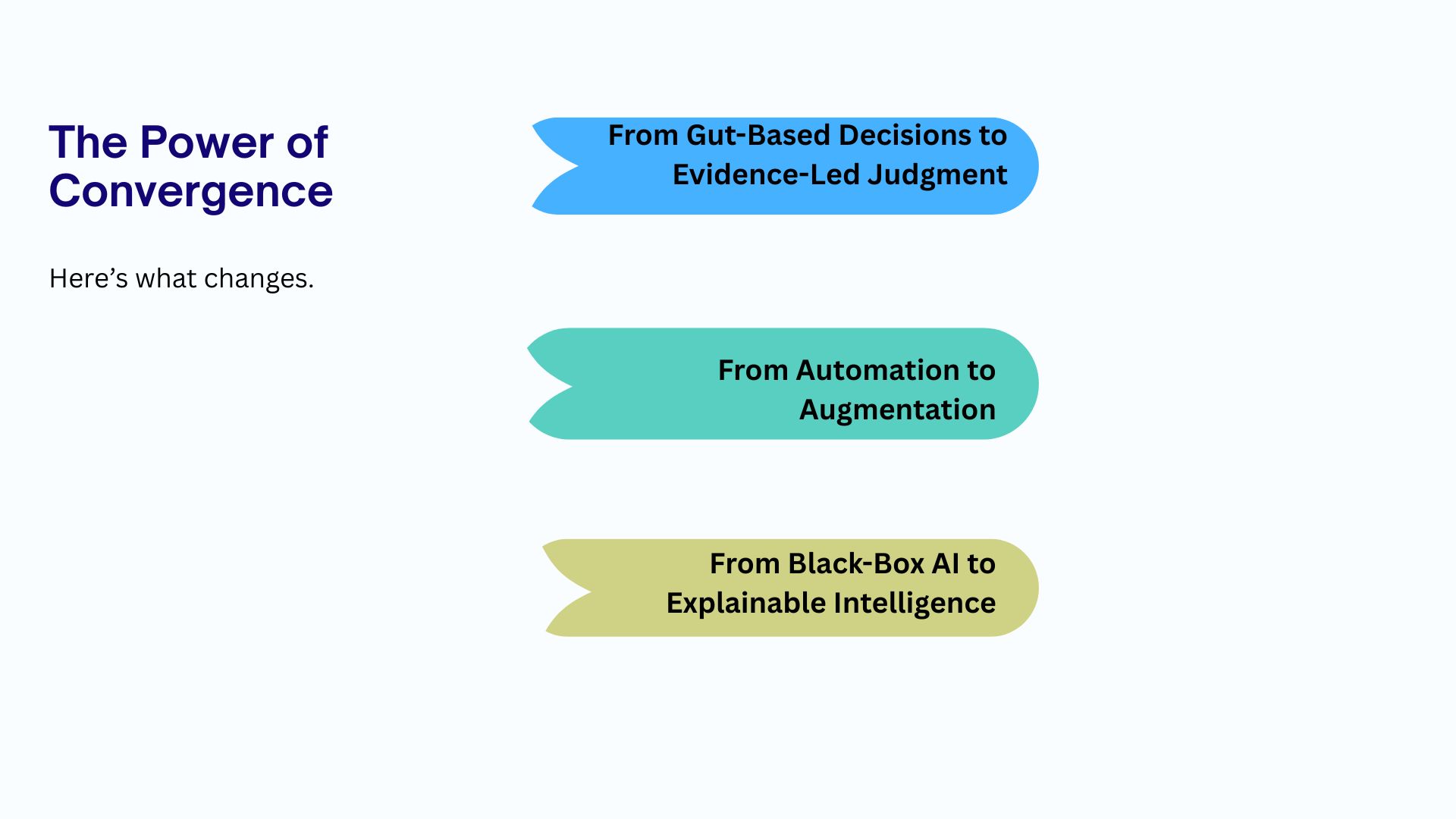
From Gut-Based Decisions to Evidence-Led Judgment
In converged systems, AI surfaces insights and probabilities, humans apply judgment, experience, and context, and decisions are both data-informed and value-driven.
For example, AI may predict customer churn, but humans decide how to intervene based on brand values and customer relationships. AI may flag operational risks, but leaders determine trade-offs between cost, speed, and resilience. This balance leads to better decisions.
From Automation to Augmentation
Many organizations focus on automating tasks. Convergence shifts the focus to augmenting human capability.
AI becomes a decision support system, not a decision replacement, a co-pilot for managers, analysts, and leaders, and a way to reduce cognitive load and improve focus.
This results in more confident decision-makers, reduced burnout, higher-quality outcomes, and greater organizational trust in AI systems.
From Black-Box AI to Explainable Intelligence
Trust is important for adoption. When humans are part of the loop AI recommendations are questioned, validated, and refined, models are continuously improved using domain expertise, and decisions are explainable and auditable.
This is especially important in regulated industries such as finance, healthcare, and government, where accountability is non-negotiable.
What This Convergence Looks Like in Practice
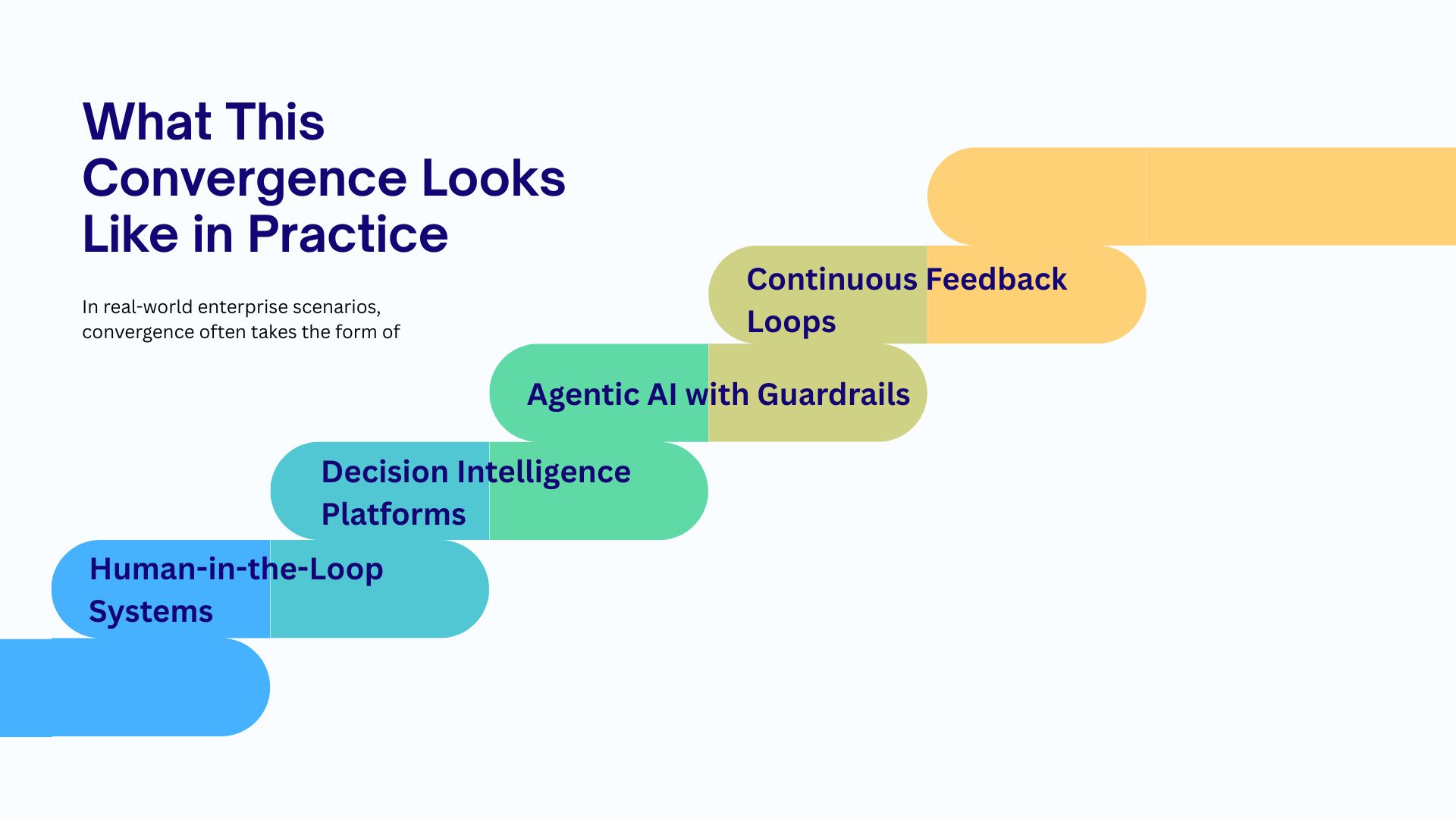
Human-in-the-Loop Systems
AI generates recommendations, but final decisions rest with humans, especially in high-impact or high-risk situations.
Decision Intelligence Platforms
Integrated platforms that combine data engineering, analytics, AI models, and business rules with human workflows.
Agentic AI with Guardrails
Autonomous AI agents perform tasks independently, but within boundaries defined by humans, aligned to business goals, ethics, and compliance.
Continuous Feedback Loops
Human feedback is used to retrain models, improve accuracy, and adapt to changing conditions.
Why Consulting Is Important to Getting This Right
This convergence does not happen automatically by deploying tools.
It requires intentional design.
Many AI initiatives fail because organizations start with technology instead of business outcomes, underestimate change management, ignore data readiness, exclude domain experts from AI design, and treat AI as an IT project rather than a transformation program. This is where a consulting-led approach makes all the difference.
PCPL’s Perspective in Designing Intelligent Enterprises
We help organizations move beyond fragmented AI adoption to cohesive, human-centered intelligence. We align AI initiatives with clear business goals, whether it’s efficiency, growth, risk reduction, or customer experience. We design modern data architectures with governance, quality, and accessibility at the core—ensuring AI has reliable fuel.
We embed transparency, ethics, and compliance into AI systems from day one. We design workflows where AI supports people ensuring adoption, trust, and long-term value. We help teams adapt by building AI literacy, redefining roles, and enabling decision-makers to confidently work with intelligent systems.
The Future Belongs to Collaborative Intelligence
The next wave of competitive advantage will not come from having more data or more advanced algorithms alone. It will come from how well organizations orchestrate the collaboration between humans and machines.
When data provides clarity, AI provides capability, and humans provide wisdom, businesses don’t just become faster or smarter. They become more resilient, responsible, and ready for the future.
References
https://www.linkedin.com/pulse/ai-decision-making-data-driven-success-loss-human-andre-0gyke/
https://www.hbs.edu/bigs/artificial-intelligence-human-jugment-drives-innovation