
As enterprise software adoption accelerates, a rift is widening between two primary models- the point solution and the platform approach. While both models offer unique advantages, understanding their fundamental differences is important for dealing with procurement, securing internal buy-in, and maximizing long-term ROI.
What is a Point Solution?
A point solution is a specialized software tool designed to solve one specific problem or perform a single primary function. Often described as off-the-shelf technology, these tools are built to be implemented quickly and used out of the box.
Think of a point solution as a specialist rather than a generalist, it does one thing very well, but it doesn’t deviate from that path.
To better understand how these tools operate, consider these defining traits as mentioned below-
- Single-Purpose Focus– They address a narrow niche, such as e-signature platforms, billing systems, or automated NDA generators.
- Ready-to-Use– They are typically designed for immediate deployment with minimal custom coding required.
- Inherent Rigidity– Because they are engineered for a specific challenge, they follow a logic defined by the developer. This often means the user must adapt their workflow to the tool, rather than the other way around.
- Limited Scope– Even if a point solution offers some add-on features, it cannot be fundamentally reconfigured to solve a different set of business problems.
While point solutions are excellent for plug-and-play efficiency, they can lead to software silos. Because they aren’t designed to handle multiple business challenges, companies often end up with a fragmented tech stack where different departments use different, disconnected tools.
What is a Platform Solution?
Think of a platform solution as a versatile foundation rather than a single-purpose tool. While standard software is built to solve one specific problem, a platform provides the infrastructure to build, automate, and scale multiple processes across an entire organization.
The main characteristics include the following-
- Scalability & Flexibility– Built to evolve as your business grows.
- Interconnectivity- They don’t live in a vacuum; they bridge the gap between external databases and existing software.
- The Tinkering Trade-off– They often require more upfront configuration than out-of-the-box software. However, this initial effort pays dividends in long-term efficiency and custom value.
The Spectrum of Platforms
Platforms vary based on how much freedom they give the user.
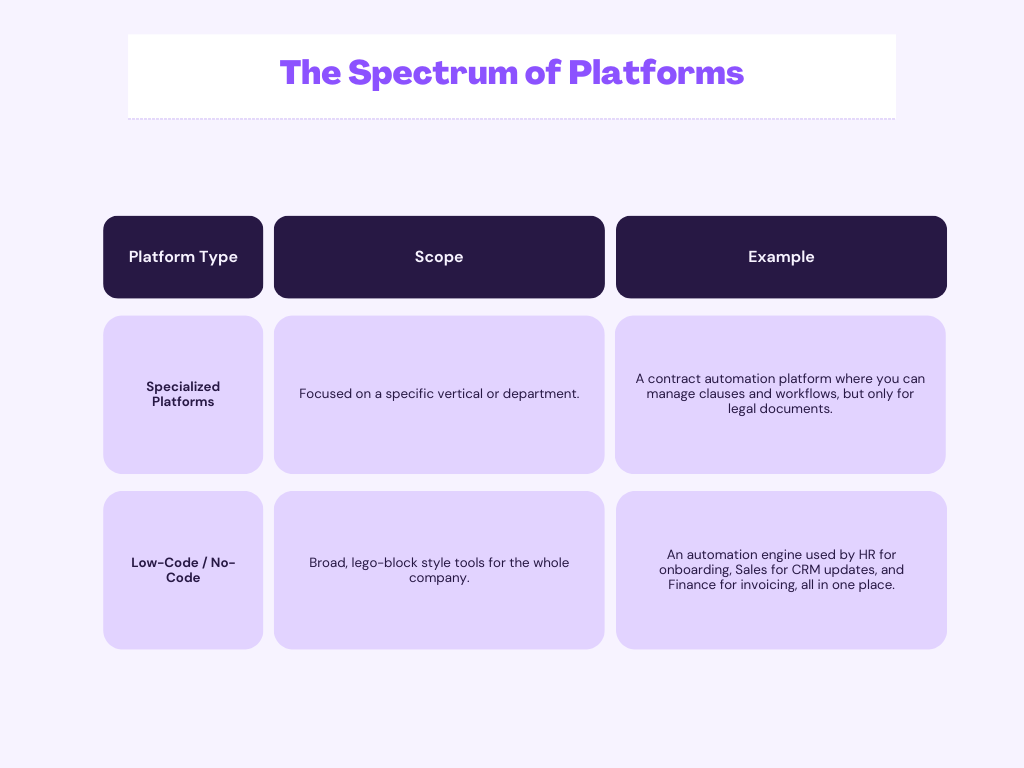
A platform solution is an environment you build within. It moves you away from one-off fixes and toward a unified digital ecosystem.
The debate between platform and point solutions usually boils down to one question- do you want a tool that does one thing well enough, or an ecosystem that does everything exactly how you need it?
Why Platforms Consistently Outpace Point Solutions In Delivering Long-Term Value?
- Radical Flexibility
Point solutions are built on compromise. To appeal to the mass market, they generalize tasks, often leaving your specific niche requirements ignored. A point solution might automate 70% of a workflow, but that remaining 30% often leaves you stuck with the same manual bottlenecks you were trying to escape. But a platform doesn’t tell you how to work; you tell the platform. It allows you to build solutions that fit your exact processes, ensuring automation actually reaches the finish line rather than just moving the goalposts.
- Exponential ROI through Consolidation
The most immediate drain on a budget isn’t just subscription costs but tool sprawl. Instead of managing separate licenses for Legal, HR, and Finance, a platform acts as a unified engine for the entire enterprise. If a platform solution automates the final 30% of a task that a point solution missed, that is a 1:1 gain in reclaimed time. Multiply that across every department, and the ROI becomes undeniable.
- A Unified User Experience
The hidden cost of point solutions is the cognitive load on your team. Switching between five different interfaces to complete one project is exhausting and inefficient. Platforms provide a single, familiar UI. When the environment stays the same, user adoption skyrockets and the learning curve for new tools disappears. Tools built on the same platform speak the same language, allowing for seamless data flow and integrated logic that disparate point solutions can’t replicate without expensive custom API work.
- Accessibility via No-Code
The value of a platform is only realized if people can actually use it. The spectrum of ease-of-use looks like this-
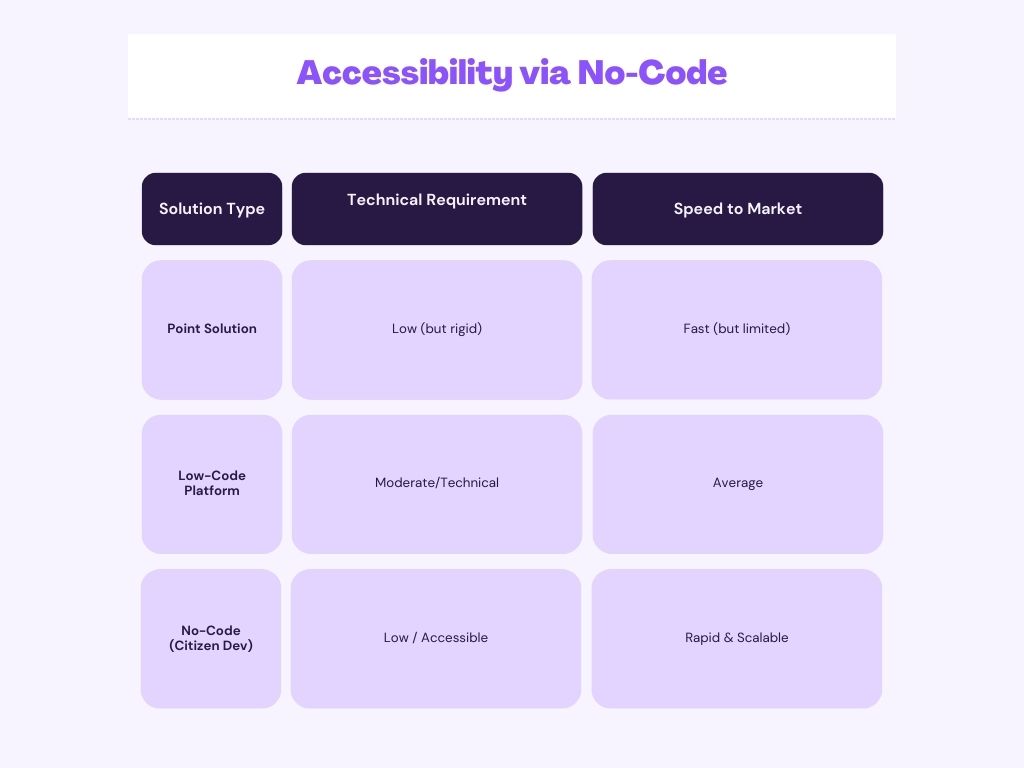
By utilizing a no-code platform, organizations empower citizen developers, the people closest to the problems, to build sophisticated, integrated solutions without needing a computer science degree.
While the shift toward comprehensive platforms is gaining momentum, the all-in-one approach shouldn’t mean all-or-nothing. High-performing tech stacks still find immense value in point solutions.
Some tasks are inherently specialized and demand the precision of a master craftsman rather than a jack-of-all-trades tool. Specialist software such as e-signature platforms or advanced Natural Language Processing (NLP) tools, offers a depth of functionality that broader platforms often lack.
The Rise of Platform Solutions
The shift toward platform-based business models is accelerating across all sectors. As the tangible ROI of low-code and no-code solutions becomes undeniable, forward-thinking organizations are moving past observation and into active implementation. If you haven’t yet explored how these platforms can optimize your operations, now is the moment to start.
References
https://neota.com/platform-v-point-solutions-making-sense-of-enterprise-technology/
https://naviant.com/blog/enterprise-platform-vs-point-solution/
https://erp.today/enterprise-platforms-vs-point-solutions/