

Reasons Most AI Initiatives Fail
If we are to go by the recent data we can see a massive shift in corporate strategy and spending. The 2024 McKinsey Global Survey on AI points that 72% of organizations have integrated AI into at least one business function, a significant leap from 50% in previous years. Further, 65% of leaders anticipate that GenAI will drive significant or disruptive change within their sectors.
This shift is backed by a financial commitment. AI spending skyrocketed to $13.8 billion in 2024, a six-fold increase from the $2.3 billion recorded in 2023. As per Informatica’s CDO Insights 2025, the vast majority of organizations adopting the GenAI plan have increased their investments throughout 2025.
The primary driver for this capital influx is the tangible promise of efficiency. A study of 35,000 workers across 27 economies found that GenAI is already transforming the daily workflow. Employees save an average of one hour per day by automating administrative tasks. One-fifth of workers report saving up to two hours daily, allowing them to shift from routine labor to high-value strategic initiatives.
The Reasons Why AI Projects Stall
Despite the enthusiasm, the path from pilot to production is filled with obstacles. AI projects currently suffer from a failure rate that is twice as high as traditional IT initiatives. On average, only 48% of AI projects actually reach the production stage. It takes approximately eight months to move from a prototype to a live environment. Gartner predicts nearly a third of GenAI projects will be scrapped due to escalating costs, unclear business value, or inadequate risk controls.
While the potential of AI is vast, the failure gap remains an urgent challenge for leadership. To translate massive investments into concrete business results, organizations must look past the algorithms and address the primary culprit of project collapse.
And to top it all there is a lack of high-quality, accessible data.
More Isn’t Enough for AI Success
It sounds like a contradiction but during times when there is data overload, how can a lack of data be the primary reason AI projects stall? Yet, that is exactly what the evidence suggests.
While we are flooded with information, organizations are finding that their reservoirs are often polluted or inaccessible for modern AI applications.
The Reality Behind the Numbers
While Generative AI (GenAI) dominates corporate strategy, the infrastructure often lags behind the ambition. According to Gartner, 39% of organizations still cite a lack of data as a top barrier to AI implementation. However, lack of data is usually shorthand for a deeper issue. The problem arises from a lack of AI-ready data.
The Top Obstacles to AI Maturity
The Global CDO Insights 2025 survey points out that the struggle is less about quantity and more about quality and culture. Data that is siloed, unlabelled, or inconsistent cannot be used to train or fine-tune models. Legacy systems often lack the architecture to support the high-velocity requirements of GenAI. Plus there is a shortage of talent capable of bridging the gap between data science and business value.
Shift Your Strategy From Management to Readiness
Most companies have spent decades perfecting traditional data management focusing on storage, basic reporting, and historical analysis. However, AI-ready data management is a fundamentally different discipline. It requires making data understandable for machine learning models, ensuring data privacy and ethics are baked into the pipeline, and moving beyond static batches to dynamic, flowing data.
To move from AI experimentation to true ROI, organizations must stop collecting data for the sake of having it and start engineering it for the sake of using it.
Important Shifts in AI-Ready Data Management Every CDO Must Master
The gap between traditional data management and AI-ready maturity is the primary reason AI projects are stalling in the pilot phase. Forging this distance is not a simple patch or upgrade; it requires a fundamental shift in how we define, govern, and scale information.
To bridge this divide, data leaders must address three core distinctions that separate modern AI-ready data from the business-ready data of the past.
1. Shift to Dynamic ContextUnlike traditional business intelligence, where data pipelines can be established and left to run, AI-ready data is a living, breathing practice. There is no universal formula for AI readiness. It is entirely dependent on your organization’s specific data maturity, skill sets, and unique use cases. Also, AI development is non-linear. As models learn and evolve, the data feeding them must be continuously managed and re-evaluated. Successful CDOs are shifting focus toward data literacy and dynamic management frameworks that can pivot as new generative AI use cases emerge.
Organizations need to ask how must their current architecture evolve to support non-static data flows, what the measurable impact of GenAI demands are on our existing skill sets and how can they operationalize governance at scale without stifling innovation.
2. Redefining QualityTraditionally high quality meant accurate, clean, and reliable. In the AI world, those parameters are necessary but insufficient. Different models require different fuel. While structured data powers predictive analytics, GenAI and LLMs thrive on vast swaths of unstructured data. Metadata becomes the essential organizer that makes this diversity accessible.
Traditional analytics often discards bad data. However, AI models may require outliers or even poor-quality samples to understand boundaries and improve training robustness. Also governance is a moving target. What is considered high quality, compliant data today might be restricted by new privacy regulations tomorrow. An AI-ready foundation must be able to forget or re-classify data instantly.
3. The Path is EvolutionaryWhile the potential of AI is revolutionary, the infrastructure behind it cannot be built overnight. There is no magic software that flips a switch to AI readiness. The majority of AI effort is spent on data preparation, RAG (Retrieval-Augmented Generation), feature selection, and prompt engineering. The actual modeling is the smallest part of the journey.
Because pre-built LLMs and models are now widely available, a company’s competitive advantage no longer lies in the model itself, but in the proprietary data foundation it is built upon. A rock-solid foundation ensures that your applications are grounded, secure, and ready to handle unknown future workloads without requiring a total system overhaul.
The Old Rules No Longer Apply In Building a Strong AI-Ready Data Foundation
Legacy data management was built for predictable, retroactive reporting. However, as organizations shift toward generative AI and machine learning, those old frameworks are showing their age. Connecting sophisticated AI models to fragmented, traditional systems creates a confidence gap that stalls projects at scale.
When AI is fueled by poor data, the results shift from minor errors to significant liabilities, ranging from embarrassing brand blunders to dangerous or libelous outcomes, such as legal sanctions or medical misdiagnoses.
Pillars of an AI-Ready Architecture
To move from experimentation to enterprise-scale AI, your foundation must integrate five critical components
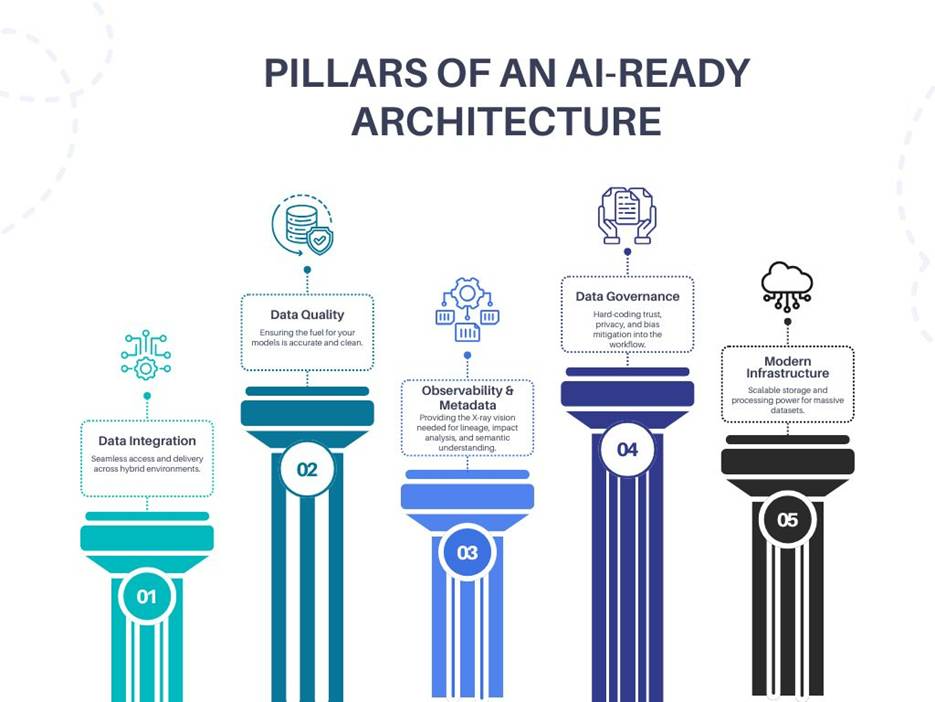
The goal is a platform that delivers data that is Relevant, Responsible, and Reliable.
1. Relevant DataAI-ready data must be transparent and contextual. You ensure AI answers are tailored to your specific business reality rather than generic hallucinations by using a universal metadata foundation. Create a single system of record that catalogs data from databases, cloud apps, and pipelines. Establish a common language that aligns data with your specific business terms and processes.
Discover and link complex data assets, for e.g., connecting specific customers to nuanced purchase patterns, to deepen AI insights. Offer self-service access to curated data products, creating better collaboration between data engineers and AI teams.
2. Responsible DataTo scale AI, it must be governed, secure, and democratized. This ensures compliance with emerging global standards like the EU AI Act. Build stakeholder trust by delivering the right data to the right roles at the precise time it’s needed. Use tagging for both structured and unstructured data to protect sensitive info and make AI decisions auditable. Drive observability across pipelines to catch anomalies and data drift before they corrupt model outputs. Ensure every service complies with the highest industry security standards to mitigate breach risks.
3. Reliable DataReliable data is complete and resilient. It reduces noise and ensures that AI predictions are grounded in reality. Efficiently ingest and prepare data from diverse sources without manual coding bottlenecks. Use data quality accelerators to clean information across different regions and industries effortlessly. Ground your AI in a single version of the truth for core entities like customers, products, and suppliers. Deploy prebuilt profiling and observation rules to ensure data remains valid and complete throughout its lifecycle.
A modern data management platform transforms store info into an enterprise asset that is relevant, responsible, and reliable enough to power the next generation of AI.
AI-Driven Data Management
Most people focus on making data AI-ready. The real winners use AI to manage that data. You unlock a new level of automation, precision, and speed by applying artificial intelligence, thus ensuring your foundation is actually strong enough to support GenAI.
Traditional data prep can take months. GenAI-powered management shrinks that timeline to near-instant results, allowing you to scale projects faster and see a return on your investment sooner.
Ready to get your data AI-ready? Discover how PCPL can transform your strategy.
#AIFailure #AIChallenges #FailuresinAI #AIProjectRoadblocks #AIImplementationFailures #AIAdoptionStruggles #AIInitiativeMistakes #AvoidingAIFailure #SuccessfulAIAdoption #PCPL
References
https://www.linkedin.com/pulse/why-ai-initiatives-failing-alejandro-mainetto-ubjie/