
Digitization is the engine on which modern business runs. Large enterprises are in a high-stakes race to boost productivity and deliver value at breakneck speeds, often by embedding AI into the heart of their digital ecosystems. To survive, organizations must remain perpetually market-ready and agile.
The reality, however, is often less seamless. Many companies are weighed down by legacy architectures, fragmented toolsets, and rigid monolithic applications. These systems lack the API connectivity needed for proper governance, creating a fragile IT landscape. When AI is layered onto this shaky foundation without a clear strategy, it scales technical debt and stalls time-to-market.
The Path to Agility with Composable Enterprise
Transitioning to a composable approach is the solution for achieving genuine business agility. Companies can shift instantly by breaking down silos into modular, interchangeable components. However, this transition isn’t a simple plug-and-play fix. Becoming a composable enterprise involves dealing through many hurdles like moving away from all-in-one software toward modular services, aligning teams to prioritize flexibility and collaborative governance over rigid hierarchies, and ensuring AI tools are integrated purposefully rather than scattered haphazardly. The journey to composability is a profound transformation that requires a dual focus on technological modernization and cultural evolution.
Think of a Composable Enterprise as a business built like a set of high-end LEGO bricks rather than a solid, unchangeable marble statue.
Coined by Gartner, this framework moves away from rigid, monolithic software systems. Instead, it treats every business function like payment processing, inventory tracking, or customer data as a modular, interchangeable building block.
The Pillars of Composability
To handle sudden market shifts a composable enterprise relies on three core areas
- Composable Thinking- A mindset that prevents silos by viewing every part of the business as flexible and integrated.
- Composable Business Architecture- Designing the organization’s structure and processes to be modular, ensuring that changes in one department don’t break the others.
- Composable Technologies- Utilizing Packaged Business Capabilities (PBCs) software components that perform specific tasks and can be swapped or scaled independently.
In a traditional setup, changing a single feature might require rewriting an entire software ecosystem.
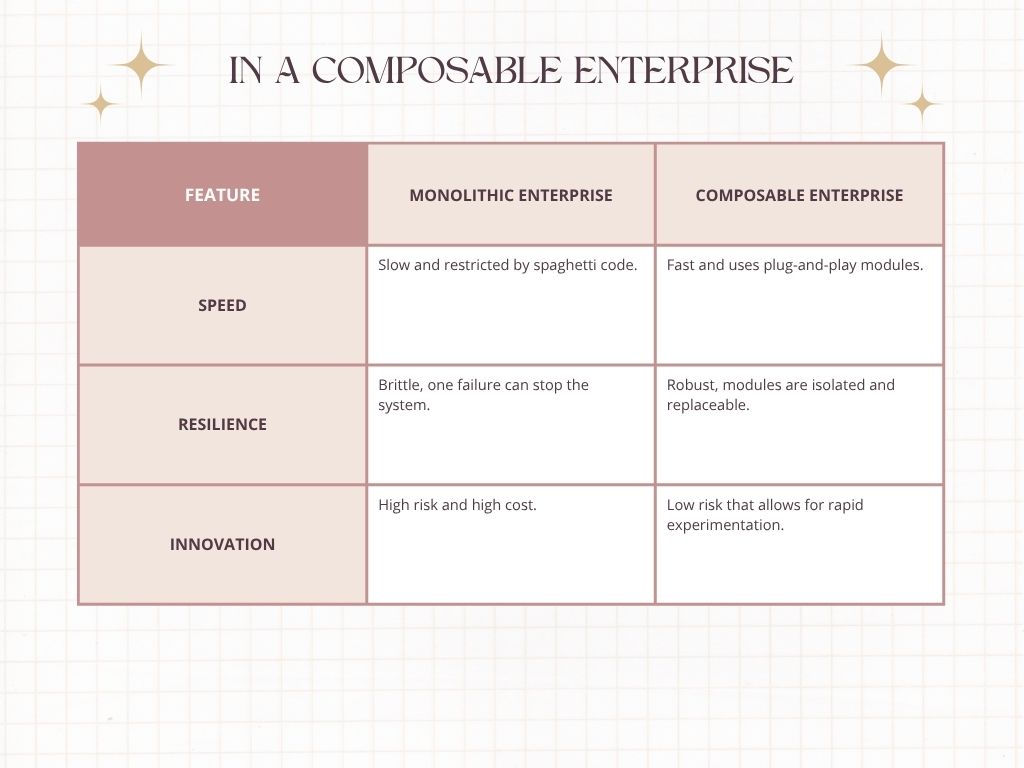
To grasp the shift from traditional business structures to a composable enterprise, imagine moving from a monolithic marble statue to a modular construction set.
While a traditional model is carved from a single, rigid block, a composable model is assembled from interchangeable parts. If a market shift requires a new feature, you don’t have to chip away at the base or risk shattering the whole statue; you simply swap a module.
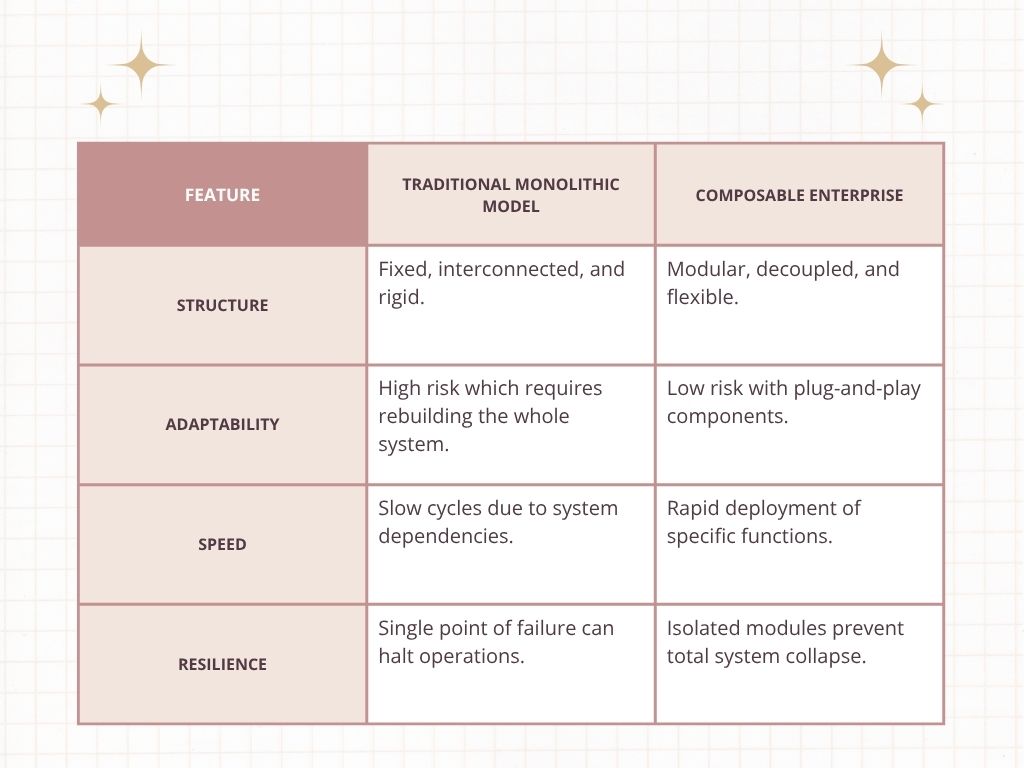
The Path to Modernization
Transitioning to this model is an organizational evolution. It requires a gradual modernization of both internal processes and external services. Every department functions as a well-oiled mechanism with clear responsibilities and the independence to innovate without waiting for a total system overhaul by equipping teams with specific, autonomous tools.
The market is voting for agility over permanence. According to Gartner, by 2027, 80% of AI-generated business applications will be 80% composable to support engineering and business speed.
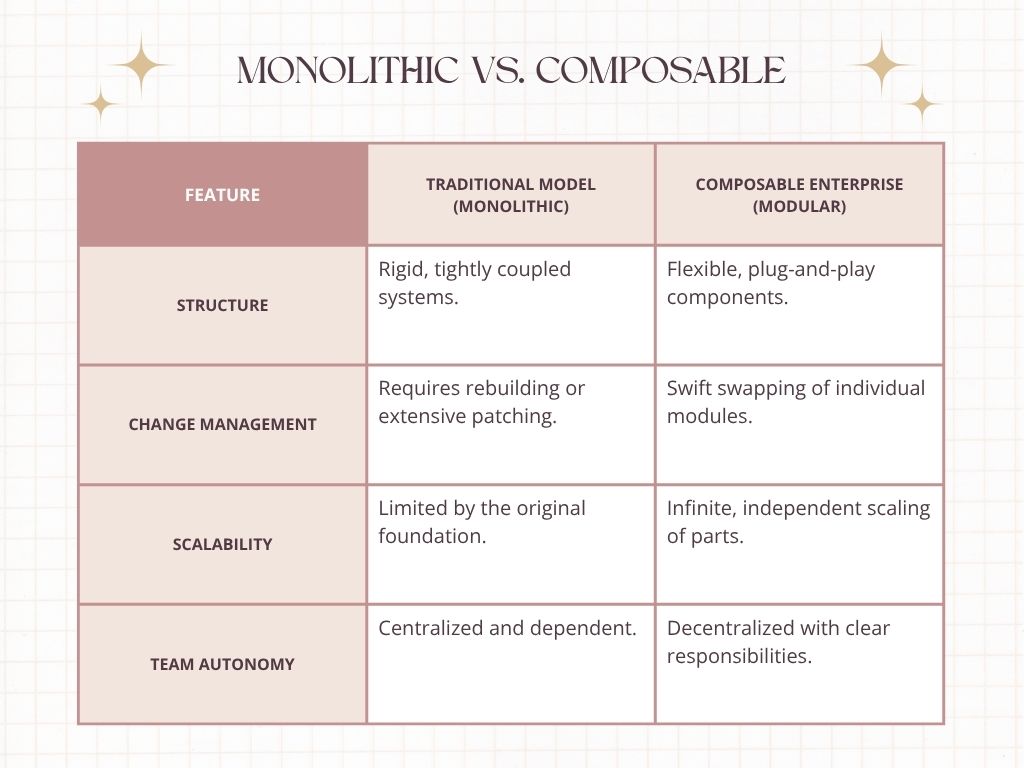
The financial data foretells projected market value to reach $11.8 billion by 2028 and growth rate expanding at a Compound Annual Growth Rate (CAGR) of 17.5%. In short, the traditional model is a monument to the past, while the composable enterprise is a living system built for the future. The shift from a traditional business model to a composable enterprise is best understood as the transition from a monolithic marble statue to a modular construction set.
In a traditional setup, the organization is carved from a single, rigid block. If you need to change a feature, you risk damaging the entire structure. In contrast, a composable model uses interchangeable blocks; when the market shifts, you simply swap a module. This fundamental change dramatically enhances operational speed, scalability, and business resilience.
The Core of a Composable Enterprise are Packaged Business Capabilities (PBCs)
Instead of leaning on rigid, monolithic legacy systems, the composable enterprise is powered by Packaged Business Capabilities (PBCs), the self-contained, modular building blocks of modern software architecture. While microservices represent a technical evolution, PBCs represent a business revolution.
A PBC bundles specific microservices together and manages them as a single product to deliver a complete, independent business outcome. Think of them as ready-to-use features that provide immediate value.
Common examples are a standalone shopping cart module or a comprehensive account management tool or a secure, plug-and-play payment system.
To ensure seamless integration and autonomy, a PBC typically consists of four key elements
- APIs- The digital glue that connects the block to the rest of the ecosystem.
- Event Topics- Mechanisms for real-time, asynchronous communication between systems.
- UI Components- Pre-built interface elements for user interaction.
- Metadata & Documentation- The models that ensure the capability is discoverable and easy for other teams to use.
PBCs bridge the gap between custom-built agility and off-the-shelf reliability. They inherit speed and the ability to make granular changes without breaking the system and provide proven reliability and the benefit of writing once, use many. Development teams, thus, no longer need to reinvent the wheel. By selecting the necessary PBCs, they can assemble bespoke solutions that are perfectly tailored to the business’s needs while drastically reducing time-to-market.
High-Stakes Hurdles Involved
1. Engineering Complexity
The sheer volume of available frameworks, microservices, and tools can lead to paralysis by analysis for developers. Without early investment in orchestration, standardization, and rigorous documentation, the flexibility of composability can quickly devolve into a chaotic, unmanageable web of tech debt.
2. Data Management & Integration
Many organizations are anchored by legacy systems that don’t speak the language of modern APIs. Connecting old databases to new modules is often brittle. Messy data acts as a bottleneck for AI innovation and if data flows are poorly managed, the resulting business insights and automated decisions will be flawed.
3. Governance and Compliance Risks
Modularity is a double-edged sword. While it decouples services, it also creates more surface area to protect. Managing dozens or hundreds of independent components and APIs without a centralized governance framework increases the risk of security breaches, privacy leaks, and regulatory non-compliance.
4. Cultural Resistance & Silos
The shift to composability is as much about people as it is about code. It requires moving away from the monolithic mindset to form multidisciplinary fusion teams. This blending of IT and business accountability often faces pushback from departments accustomed to working in silos or following traditional top-down hierarchies.
5. The Specialized Skill Gap
Successfully executing a composable strategy requires a deep understanding of Domain-Driven Design (DDD) and modern cloud-native architecture. Organizations often find themselves at a crossroads- embark on a massive upskilling program for current staff or compete in a high-demand market to recruit specialized talent.
6. High Initial Operating Costs
While composability saves money in the long run through efficiency and reuse, the buy-in price is steep. Upfront investments are required for advanced orchestration tooling, comprehensive architectural planning, the initial integration of components, and highly skilled (and expensive) personnel.
To successfully shift toward a modular future, organizations require a high-performance composable platform.
Adopting a composable platform is an intentional move to ensure your technology stack is never a bottleneck. It aligns your digital infrastructure with your broader enterprise roadmap, ensuring that agility, security, and intelligence are integrated from day one.
By shifting from a rigid, all-in-one system to a modular platform, a composable enterprise transforms volatility into a competitive advantage. By leveraging Packaged Business Capabilities (PBCs), organizations can move faster, spend smarter, and stay resilient.
References
https://www.processmaker.com/blog/the-composable-enterprise/
https://mia-platform.eu/blog/composable-enterprise/
https://www.contentstack.com/blog/composable/why-composable-business-is-the-key-to-digital-success