
Importance of AI Governance in Keeping AI Explainable and Accountable
While AI is a powerful driver of industry innovation, its adoption brings in significant ethical, security, and compliance risks. Effective AI governance mitigates these concerns by establishing robust frameworks and risk management strategies. To ensure responsible operations, organizations should integrate governance into existing policies, adopt a risk-based perspective, and utilize continuous monitoring.
AI Governance is the strategic framework of policies and regulations designed to guide the ethical development and use of artificial intelligence. It integrates compliance, security, and risk management to ensure AI systems are transparent, fair, and accountable. Governance allows organizations to innovate responsibly while protecting against bias, privacy breaches, and opaque decision-making by aligning with global benchmarks like the EU Act and OECD Principles.
Implementation & Strategy Behind AI Governance
To be effective, AI governance cannot exist in a vacuum. It must be woven into the fabric of an organization’s data protection mandates, compliance protocols, and ethical AI policies. Organizations ensure that governance frameworks are not just theoretical, but operational by promoting cross-functional collaboration. This alignment strengthens the overall security posture and ensures agility in the face of evolving global regulations.
1. Change ManagementThe shift toward governed AI often requires a fundamental change in organizational culture. A robust change management strategy minimizes friction and accelerates adoption through the following-
● Executive Sponsorship– Securing top-down commitment to prioritize AI ethics and compliance.
● Governance Committees– Establishing a dedicated body to oversee ethical considerations and regulatory alignment.
● Structured Incident Response– Creating clear protocols for when AI systems deviate from expected behavior.
● Cross-Functional Synergy– Breaking down silos between IT, Legal, HR, and Product teams to ensure holistic oversight.
2. The Risk-Based Implementation ModelRather than applying a one-size-fits-all approach, organizations should prioritize resources based on the potential impact of each AI system. This strategy ensures compliance while maintaining innovation speed.
● Risk Frameworks– Deploying standardized tools to identify and mitigate AI-specific vulnerabilities.
● Algorithmic Transparency– Utilizing interpretable models to ensure that AI decisions can be explained, audited, and defended.
● Iterative Response Plans– Strengthening the organization’s ability to pivot when high-risk scenarios emerge.
3. Evaluating Model vs. Use Case RiskEffective governance distinguishes between the technical risk of a model and the contextual risk of its application.
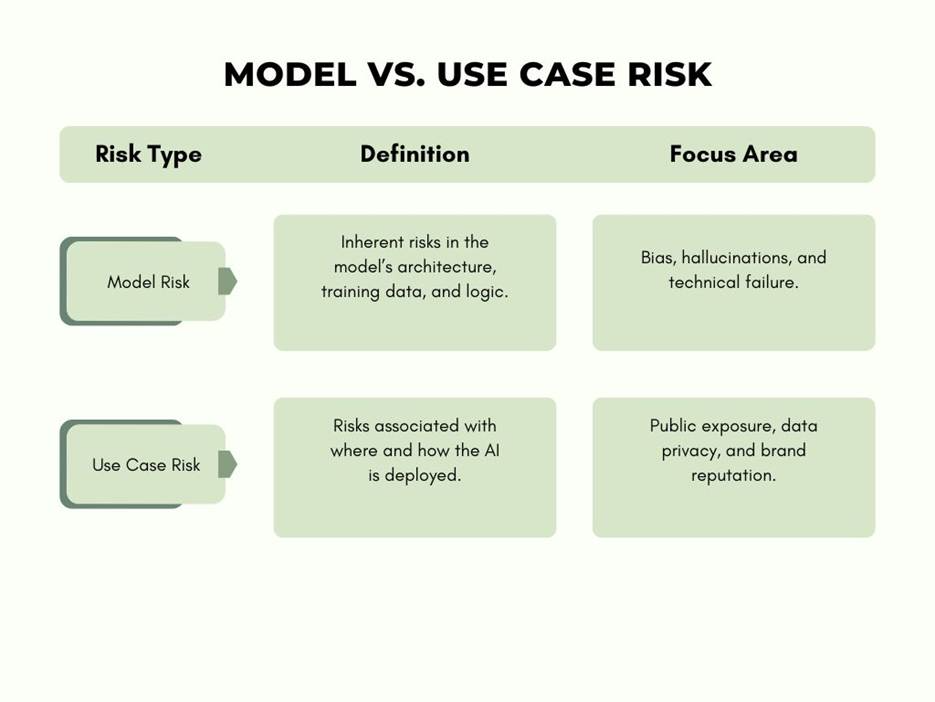
Example– An internal tool for summarizing meeting notes carries low risk. Conversely, a public-facing AI agent handling customer financial data carries high risk, requiring rigorous guardrails against misinformation and security breaches.
4. Operationalizing OversightTo ensure accountability, organizations should implement the following three-pillar system
- Risk-Based AI Classification– Tiering AI applications (e.g., Low, Medium, High, Prohibited) based on their function and user exposure.
- Attestation & Evidence Collection– Maintaining a paper trail of documentation that proves how AI decisions are reached.
- Continuous Impact Assessments– Regularly auditing AI tools to evaluate real-world consequences and adjusting governance levels as the technology evolves.
Principles, Frameworks, and Strategic Integration of AI Governance
AI governance provides the necessary guardrails to ensure that artificial intelligence remains a force for good. Without structured oversight, AI risks entrenching systemic biases, operating through black-box logic, and compromising data privacy. Organizations can align technological advancement with ethical integrity and regulatory requirements by implementing robust governance frameworks.
The Pillars- Transparency, Accountability, and Fairness
To build public and organizational trust, AI systems must be anchored by three primary values listed below-
● Transparency & Explainability– AI should not be a black box. Utilizing Explainable AI (XAI) techniques, such as model visualization and interpretability tools, allows stakeholders to understand the why behind a specific output.
● Accountability– Responsibility must be clearly assigned. This often involves appointing a Chief AI Ethics Officer or forming a dedicated AI Governance Committee. Maintaining detailed audit trails ensures that every automated decision can be traced back to its data inputs and algorithmic logic.
● Fairness– Governance must actively combat algorithmic bias. Organizations utilize demographic parity assessments and bias detection tools to ensure that AI does not discriminate based on protected characteristics like race, gender, or age.
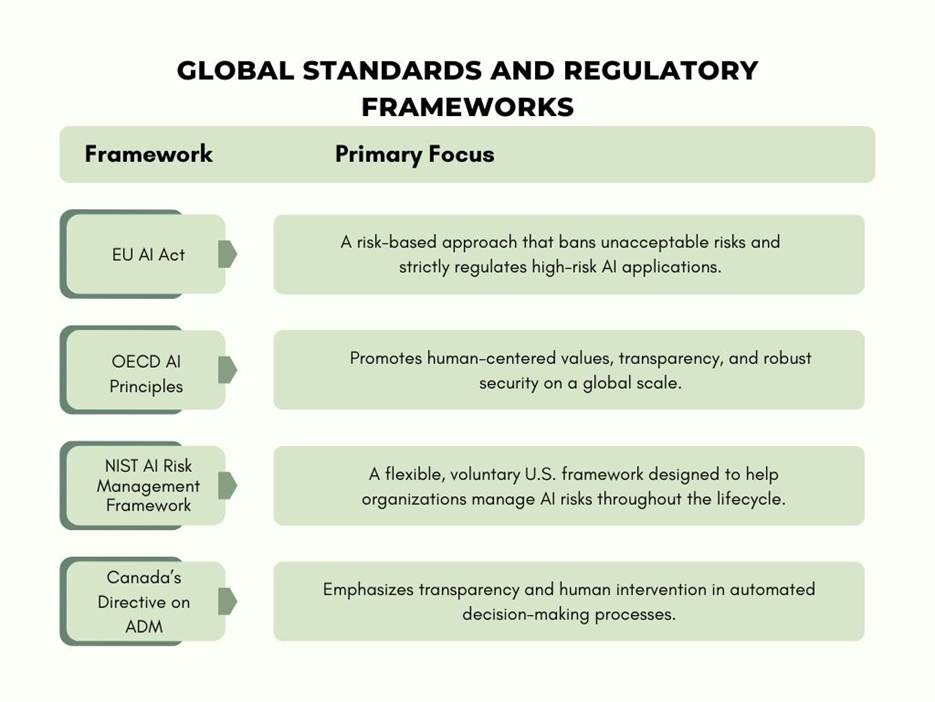
Global Standards and Regulatory Frameworks
As AI becomes a global utility, international bodies have established frameworks to standardize safety and ethics. Aligning with these helps organizations maintain cross-border compliance.
Strategic Integration
Effective governance should not be a roadblock to progress; rather, it should be an engine for responsible innovation. Instead of treating ethics as a final check-box step, leading organizations embed governance directly into the DevOps and AI development workflows.
● Continuous Monitoring– Real-time tracking of model performance to detect “drift” or emerging biases.
● Agile Governance– Adapting oversight policies as the technology evolves, ensuring that safety measures don’t stifle experimentation.
● Trust as a Competitive Advantage– Organizations that prioritize ethics often see higher user adoption and lower legal friction, allowing them to scale more effectively than those ignoring these risks.
Businesses can harness the full potential of AI while safeguarding the human values that underpin their success by promoting a culture of accountability and implementing rigorous fairness assessments.
Bridging Innovation and Environmental Sustainability with AI Governance
As AI adoption accelerates, so does its footprint on our planet. From the immense energy required to train Large Language Models (LLMs) to the ethical complexities of hardware manufacturing, sustainability is a core pillar of AI governance now. Organizations that embed environmental responsibility into their AI strategies do more than just reduce harm; they future-proof their operations for a regulatory landscape that increasingly demands responsible technology.
The Environmental Footprint of AI
Modern AI, particularly deep learning, is computationally expensive. This demand for power translates directly into significant carbon emissions from the data centers that house these systems.
To mitigate these impacts, governance frameworks should prioritize the following-
● Algorithmic Efficiency– Developing “leaner” models that achieve high performance with less computational waste.
● Training Optimization– Scheduling training runs during off-peak hours or in regions with cleaner energy grids.
● Infrastructure Shift– Transitioning AI operations to data centers powered by 100% renewable energy.
Ethical Sourcing and the Circular Economy
Sustainability in AI extends to the physical world. The hardware required for AI, GPUs and specialized chips, relies on rare earth minerals often extracted under questionable ethical and environmental conditions.
Effective AI governance must include policies that
- Audit Supply Chains– Ensure transparency in the sourcing of raw materials for AI hardware.
- Adopt Circular Practices– Implement programs for hardware recycling, refurbishment, and responsible e-waste disposal.
- Promote Longevity– Design systems that maximize the lifecycle of existing hardware to reduce the need for constant extraction.
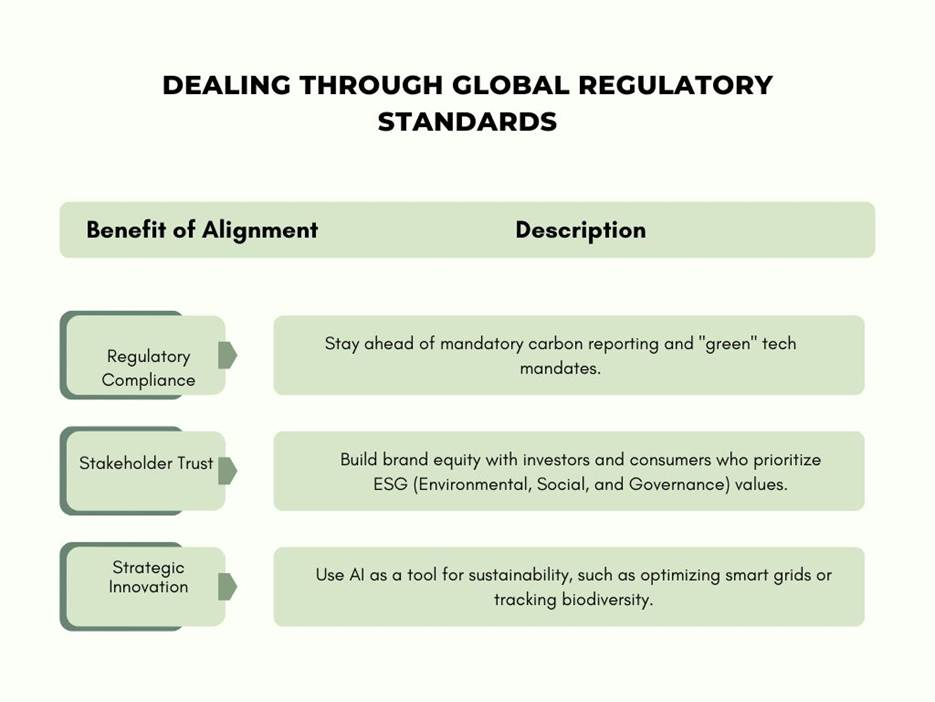
Dealing Through Global Regulatory Standards
Governments are no longer viewing AI and sustainability as separate issues. Frameworks such as the OECD AI Principles and the European Commission’s AI Ethics Guidelines explicitly link responsible AI with environmental well-being.
Finding the Equilibrium
The goal of AI governance is not to stifle progress, but to ensure that innovation does not come at the cost of the environment. Businesses can achieve a triple bottom line- Performance, Profit, and Planet by embedding sustainability into the DNA of AI development. Building a sustainable AI strategy today ensures that the technological breakthroughs of tomorrow are resilient, ethical, and ecologically sound.
Dealing Through the Challenges of AI Governance
AI governance is the cornerstone of responsible deployment, yet its implementation is fraught with complexity. From the friction of data privacy laws to the technical black box of deep learning, organizations must move beyond reactive measures to proactive, structured frameworks. Without this oversight, AI shifts from a strategic asset to a significant corporate liability.
1. Data Privacy and Compliance HurdlesData is the fuel for AI, but it is often sourced from sensitive personal information. As global regulations like GDPR and CCPA tighten, the margin for error shrinks. To maintain compliance, organizations must focus on-
● Regulatory Alignment- Mapping AI data flows directly to specific privacy rights and legal mandates.
● Secure Orchestration– Implementing Privacy by Design to prevent breaches during the training and inference phases.
● Ethical Data Stewardship– Ensuring data usage doesn’t just meet the letter of the law but also aligns with broader ethical expectations to preserve consumer trust.
2. The Transparency and Explainability GapModern AI, particularly deep learning, often operates as a black box- where the path from input to output is obscured. In high-stakes sectors like healthcare or finance, an unexplainable decision is a dangerous one. To bridge this gap, organizations are adopting-
● Explainable AI (XAI)– Utilizing techniques like SHAP or LIME to quantify which factors influenced a specific decision.
● Interpretability Tools– Using visualization layers to help non-technical stakeholders understand model logic.
● Fairness Audits– Regularly checking outcomes to ensure they don’t inadvertently codify systemic biases.
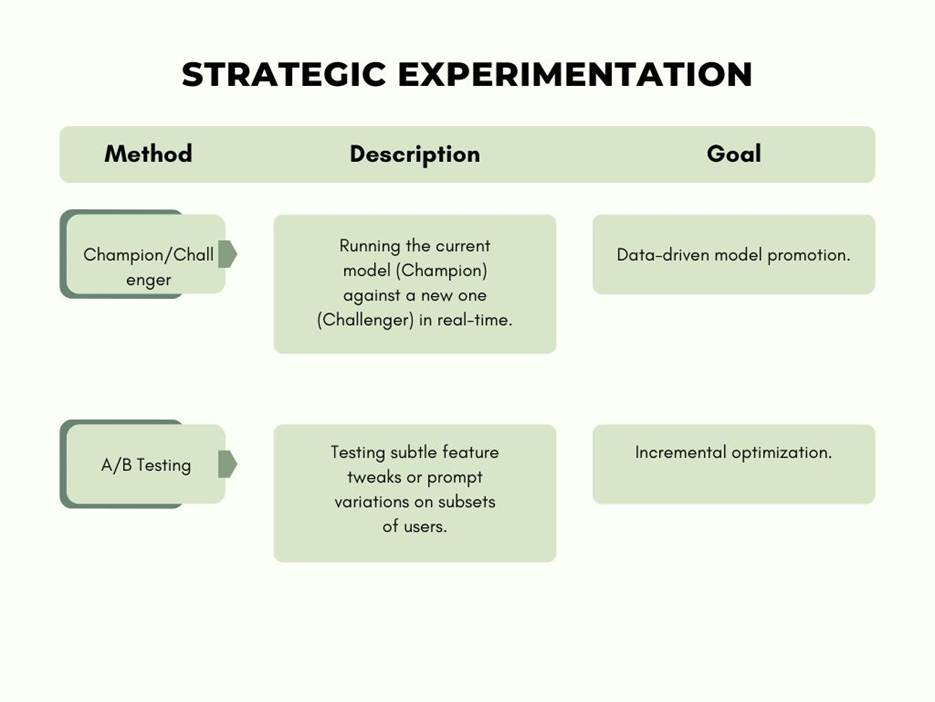
3. Reliability Through Backtesting and ExperimentationGovernance requires continuous validation. Reliability is built through a rigorous backtesting harness that compares current models against new iterations or prompts.
Backtesting for Validation
● Historical Benchmarking– Comparing past AI predictions against actual historical outcomes to gauge real-world accuracy.
● Regression Testing– Ensuring that model updates or new “system prompts” don’t introduce new errors or degrade performance.
● Risk Detection– Identifying drift, where a model’s performance decays as the real world changes.
4. Fortifying the AI Security PostureAI introduces unique attack vectors that traditional cybersecurity may overlook. Organizations must defend against-
● Adversarial Attacks– Instances where malicious actors provide “noise” or specific inputs to intentionally mislead a model.
● Model Inversion/Extraction– Attempts to reverse-engineer sensitive training data or the model’s proprietary logic.
● Infrastructure Vulnerabilities– Weaknesses in the AI pipeline that could allow unauthorized access to decision-making engines.
Accountability by Design
The hurdles of AI governance, privacy, transparency, reliability, and security, are significant but manageable. The solution lies in cross-functional collaboration, where legal, technical, and executive teams work in tandem. Businesses can build innovative AI systems that are as accountable as they are powerful by viewing governance as an ongoing journey rather than a one-time hurdle.
#AIGovernance #ExplainableAI #AccountableAI #AIethics #AItransparency #GovernanceForAI #DigitalGovernance #TechGovernance #AIresponsibility #AIregulation #PCPL
References
https://www.singlestoneconsulting.com/blog/ai-governance
https://www.informatica.com/resources/articles/ai-governance-explained.html
https://neurom.in/ai-governance-ensuring-ethical-and-responsible-ai-use/