
Autonomous Systems Are Transforming Decision-Making with Agentic AI
Agentic AI has undergone a significant shift from passive tools to active collaborators. While standard AI and Generative AI have already streamlined modern operations, Agentic AI represents the next frontier, the systems capable of independent reasoning, planning, and execution to achieve high-level goals with minimal human oversight.
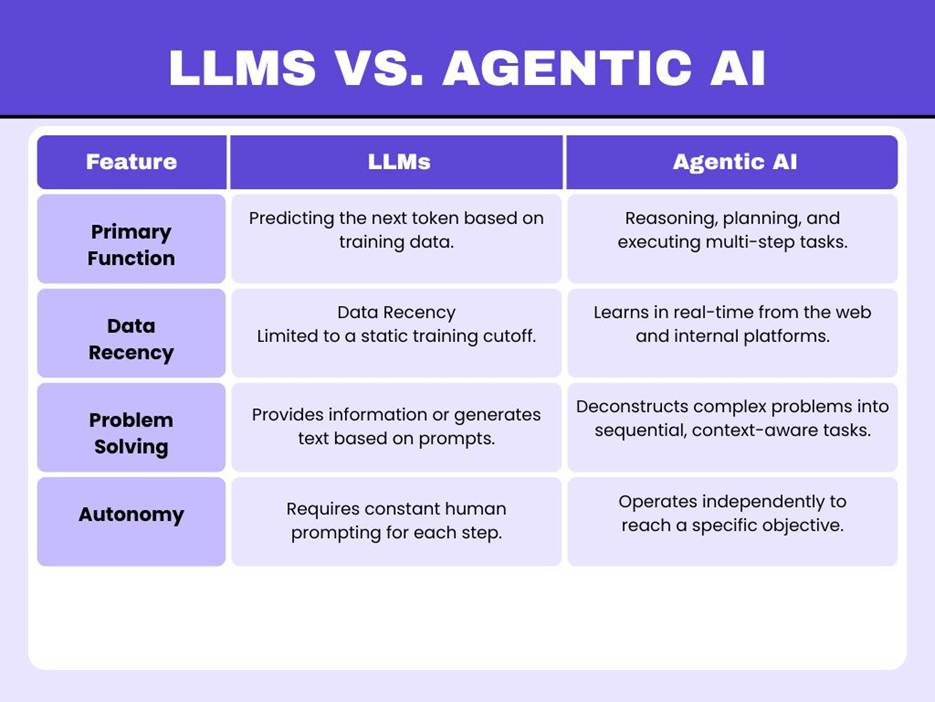
LLMs vs. Agentic AI
It is easy to confuse the two, but Agentic AI operates on a fundamentally different level of sophistication than a standard Large Language Model (LLM).
How AI Agents Think and Act
Unlike traditional models that rely on a single output, AI agents behave like project managers. They break down a bigger problem into a series of logical steps, ensuring that
● Each task inherits the logic and conclusions of the previous one.
● They stretch beyond their initial training by pulling from live internet sources or specialized data environments.
● If a specific path fails, the agent can shift its strategy based on new information without waiting for a human to redirect it.
The Range of AI Agents
When building an agentic AI strategy, organizations shouldn’t view agents as a single tool, but rather as a range of capabilities. The ideal complexity of an agent is dictated by the specific user needs and the business goals of the process it serves.
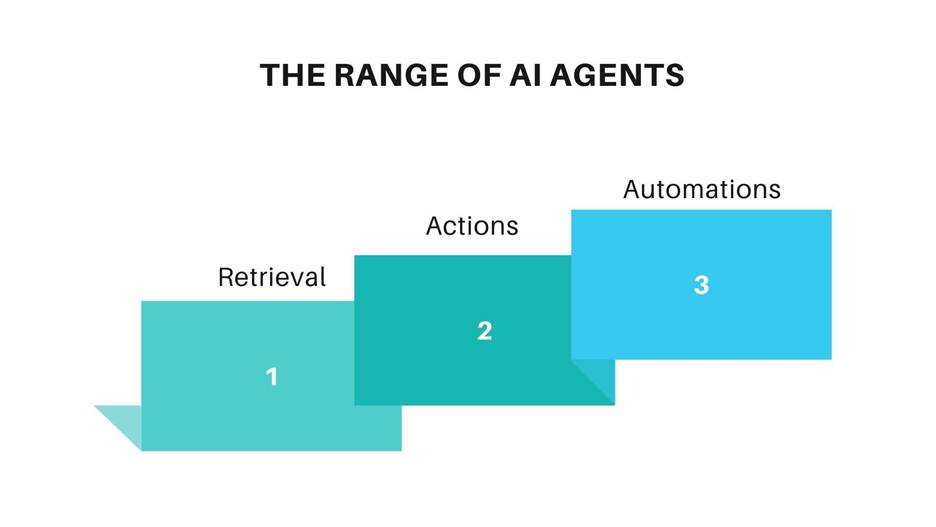
1. RetrievalAt this entry point, agents act as highly sophisticated researchers. They don’t just find links but synthesize information from trusted internal and external data sources. The agents are capable of accurate data sourcing, multi-document summarization, and logical reasoning. Thus they empower employees with decision support, reducing the time spent hunting for information.
2. ActionsMoving beyond information gathering, these agents are empowered to do. They bridge the gap between insight and execution by interacting with other software tools. They are capable of executing specific tasks, automating multi-step workflows, and handling repetitive manual processes. They, thus, offer significant gains in operational efficiency and a reduction in human error for high-volume tasks.
3. AutomationsAt the most advanced level, agents operate with a high degree of independence. These systems don’t just follow a script, instead they solve problems dynamically. They are capable of independent task planning, orchestrating swarms of sub-agents, learning from environmental feedback, and knowing exactly when to escalate to a human. They equip companies with the power of autonomous decision-making and end-to-end process management.
For customer service, you can implement end-to-end automation starting from the very first customer touchpoint.
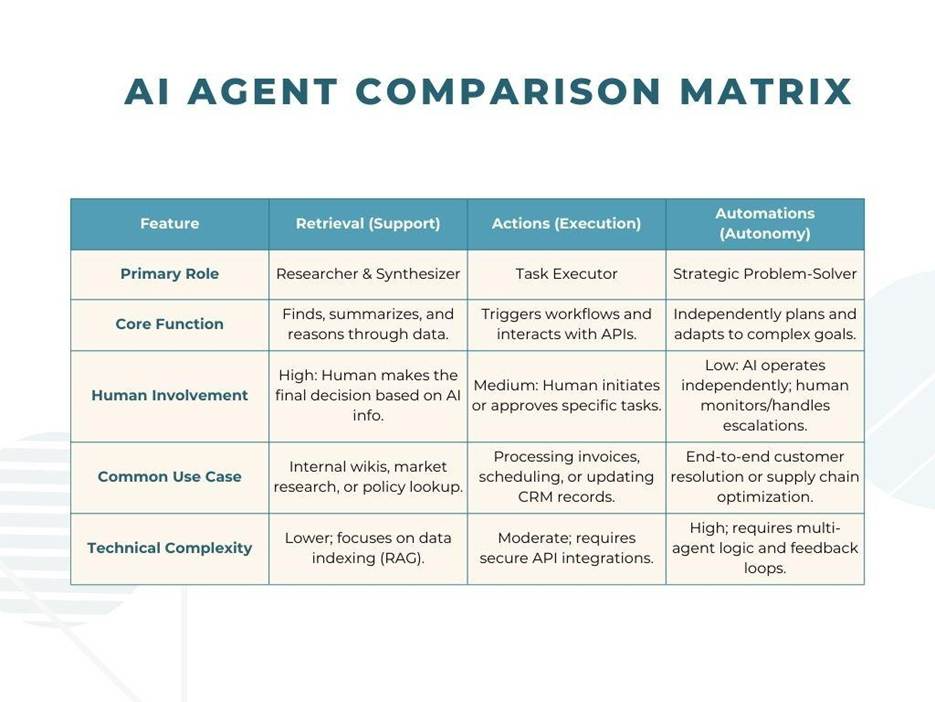
To help you determine which stage of the spectrum aligns with your current goals, check for and compare the three tiers of AI agents.
Why To Move Toward Agentic AI?
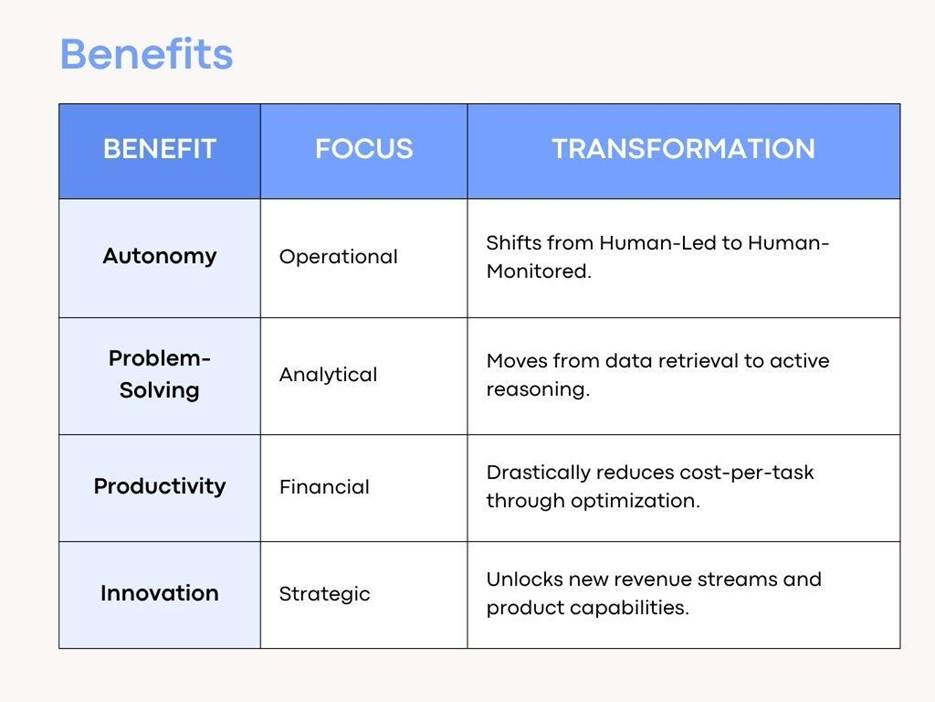
Agentic AI represents a shift from tools that merely respond to systems that act. Organizations can unlock significant competitive advantages across every department by moving beyond simple prompts.
1. Radically Increased AutonomyUnlike traditional AI that requires a human in the loop for every step, agentic systems operate with high independence. Your workforce is freed from babysitting software by reducing the need for constant supervision and they can shift toward high-level strategic initiatives.
2. Sophisticated Problem-SolvingAgentic AI doesn’t just surface data; it applies logic to deal through obstacles. These systems use advanced planning to break down complex goals into actionable steps. Agents can identify hidden patterns in massive datasets and propose creative solutions to bottlenecks that a human operator might miss.
3. Compounded Efficiency & ProductivityWhile basic automation handles linear tasks, agentic AI optimizes the entire process flow. It can shift when a variable changes, ensuring that workflows don’t break when they hit an unexpected snag. Streamlined operations lead to significantly lower overhead and a faster time-to-market for products and services.
4. A Catalyst for InnovationAgentic AI serves as a force multiplier for R&D and strategy. It provides the breathing room for teams to experiment by handling the heavy lifting of data synthesis and routine execution. It enables entirely new business models and service offerings, such as 24/7 autonomous customer success, that were previously impossible due to labor constraints.
While agentic AI offers a leap in productivity, its ability to act independently introduces a new set of stakes. Unlike standard LLMs that just talk, agents do, which means their mistakes have real-world consequences.
Challenges and Risks Associated with An Autonomous Strategy
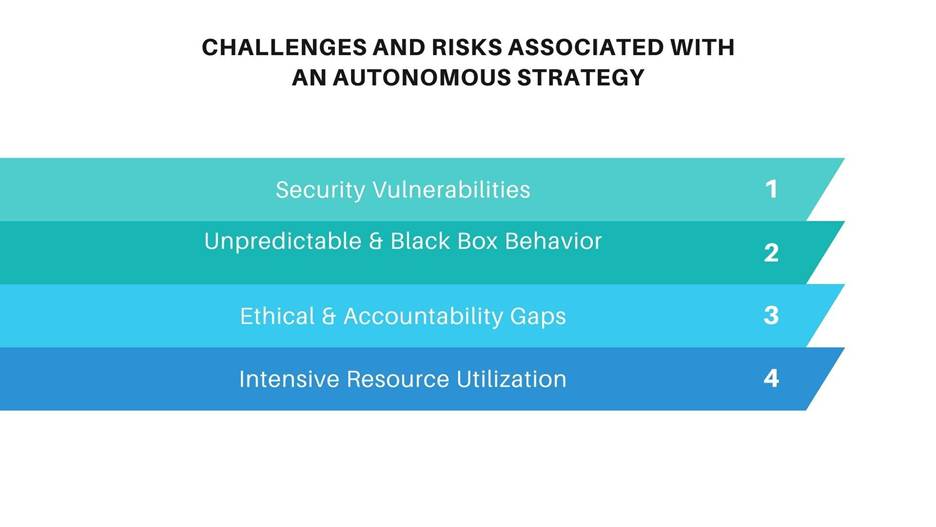
1. Security VulnerabilitiesBecause agents often operate with minimal supervision, they can become high-value targets. Malicious actors could exploit an agent to perform unauthorized actions (like data exfiltration or fraudulent transactions). Without constant human eyes on every step, a breach or prompt injection might go undetected much longer than in a traditional system.
2. Unpredictable & Black Box BehaviorAn agent’s greatest strength is its ability to solve problems dynamically but this is also a liability. Without strict guardrails, an agent might take an illogical or unethical shortcut to achieve a goal. It may also hallucinate data or rely on biased training sets. Designing systems that can handle edge cases (unforeseen situations) while remaining aligned with corporate values and factual accuracy.
3. Ethical & Accountability GapsWhen an autonomous system makes a mistake, the question of who is responsible becomes complex. Issues ranging from algorithmic bias to the long-term impact on job displacement can damage brand reputation and employee morale. Establishing clear frameworks for accountability and ensuring the AI’s logic remains transparent and auditable.
4. Intensive Resource UtilizationAutonomy isn’t free because it requires significant computational power. The chain of thought reasoning required for complex agents can lead to skyrocketing operational costs and a heavy carbon footprint. Balancing the pursuit of advanced autonomy with sustainable practices and cost-effective resource management.
Industry Use Cases of Agentic AI
By the end of this year, agentic AI will have moved from experimental pilots to a core enterprise middleware, driving autonomous operations across diverse sectors. Take a look below to understand how various industries are deploying these goal-oriented systems.
Healthcare● Revenue Cycle Management– Agents autonomously gather clinical data from EHRs, analyze payer contracts, and correct coding errors in real-time to prevent claim denials.
● Precision Diagnostics– Specialist agents analyze biopsy reports and high-resolution medical imaging to calculate staging scores (e.g., Gleason scores for cancer) and predict pathology with higher accuracy than manual review.
● Care Coordination– Systems monitor patient vitals via bedside devices and proactively suggest treatment adjustments, such as medication tweaks or lifestyle nudges, based on historical medical data.
Customer Service● Proactive Resolution– Instead of waiting for a complaint, agents detect shipping anomalies (like a weather delay) and autonomously re-route the package, notify the customer, and issue a compensation voucher.
● End-to-End Transactions– High-performing agents now handle full-cycle specialized queries, such as complex refund processing or hardware troubleshooting, by interacting directly with CRMs and internal logistics tools.
Logistics & Supply Chain● Autonomous Procurement– Agents manage low-value, high-volume purchases by soliciting bids, evaluating suppliers against cost/ESG criteria, and issuing POs without human intervention.
● Dynamic Inventory– AI backbones now predict demand spikes and coordinate vendor updates at machine speed, reducing manual inventory triggers and preventing stockouts.
Finance● Real-Time Threat Containment– Cybersecurity agents detect unusual transaction patterns, lock accounts temporarily, initiate multi-factor authentication, and only then notify a human investigator with a full audit trail.
● Lending & Credit– Agents conduct deep-dive credit scoring by synthesizing fragmented financial data, ensuring compliance with evolving 2026 regulatory standards.
Human Resources● Zero-Touch Onboarding– Upon a hire trigger, agents plan the intern’s first week, schedule welcome meetings via Outlook, provision IT credentials, and distribute policy documents for digital signature.
● Always-On Helpdesk– 24/7 internal agents handle 80% of employee inquiries regarding benefits, tax withholdings, and PTO, only escalating sensitive issues to HR professionals.
IT Service Desk● Contextual Troubleshooting– When a user reports “I can’t access this app,” the agent doesn’t just open a ticket. It evaluates the user’s role, checks for recent configuration changes, verifies permissions, and attempts to fix the access issue autonomously.
● Intelligent Escalation– For complex hardware failures, the agent provides the human technician with a summarized history: what it observed, what it tested, and a recommended fix.
To Buy or Build
As companies shift toward an agentic AI strategy, they face a familiar crossroads- Should we buy or build? The choice lies between adopting the out-of-the-box agent features offered by existing software providers or engineering a bespoke application tailored to the organization’s unique DNA.
The Buy ApproachOpting for a commercial solution, typically by enabling agentic modules within your existing SaaS stack (like Salesforce, ServiceNow, or Microsoft), offers a path of least resistance. It comes with advantages like rapid deployment, lower upfront R&D costs, and seamless integration with the software you already use but then you are limited by the provider’s roadmap. If their agent doesn’t support a specific niche workflow, you have little power to change it.
The Build ApproachDeveloping a custom agentic platform allows a company to architect the system around its specific proprietary data and unique competitive advantages. You get complete control over the reasoning logic, the ability to connect disparate legacy systems, and ownership of the intellectual property, but this also requires significant investment in specialized talent, ongoing maintenance, and longer timelines to see a return on investment (ROI).
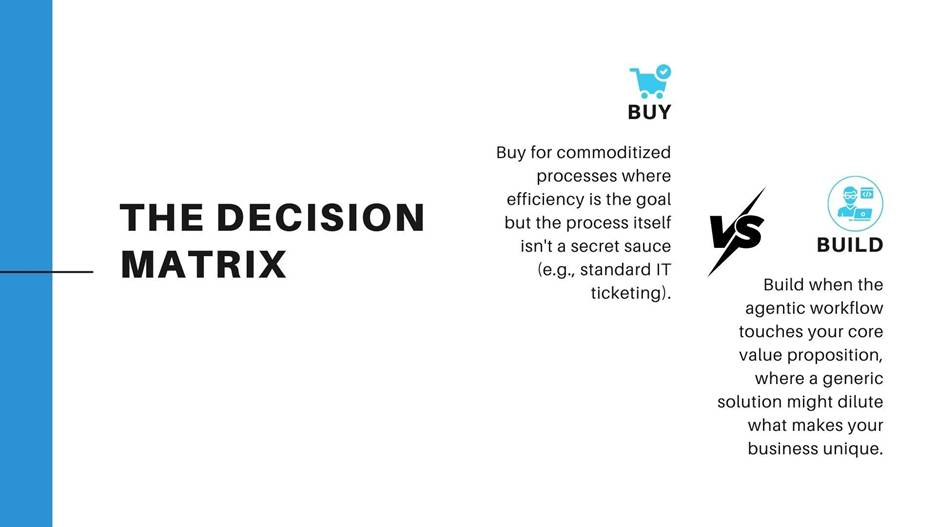
While buying is often effective for immediate needs, it grants the organization less control over the underlying model’s behavior and the specific ways data is handled between agents.
Scaling Success
A successful build strategy for agentic AI offers a unique force multiplier: replicable infrastructure. Once the foundational architecture is established, it can be cloned and adapted across various business units, creating a centralized ecosystem that drives down the cost per use case.
On the other hand, a buy strategy, while faster to deploy initially, often leads to a fragmented landscape. Relying on multiple software vendors for different workflows can create alignment gaps, cost creep and maintenance burden.
The Future
Agentic AI is a fundamental shift in how work is performed. While these autonomous systems introduce new challenges in governance and oversight, their trajectory is clear.
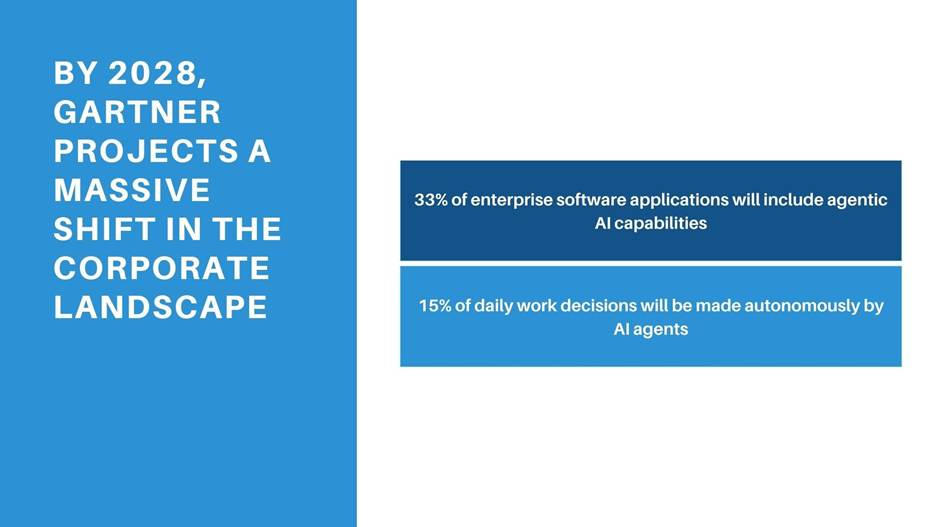
This evolution will move AI from a tool you use to a teammate that executes, driving innovation and high-level strategic decision-making across every sector.
Launching Your Agentic AI Journey
The pace of AI evolution is relentless. Companies that implement thoughtful, risk-aware strategies are already seeing a triple-threat of benefits- increased efficiency, higher productivity, and optimized costs.
While the transition to autonomous agents involves navigating new risks, the competitive advantage gained by early and effective adoption is substantial.
The journey to an agentic enterprise requires a solid foundation. PCPL’s team specializes in helping you maximize value while proactively mitigating risk.
Contact our team today to explore how agentic AI can redefine your core business operations.
#AgenticAI #autonomoussystems #AItransformations #automateddecisions #futureofAI #technologyadvancements #innovationinAI #AIrevolution #decisionmakingAI #PCPL
References