
AI-Enabled or AI-Driven? What Kind is Your Enterprise?
There’s a quiet but important distinction emerging in boardrooms today, one that will define the next decade of winners and losers. Most organizations proudly claim they are AI-enabled but very few can truly say they are AI-driven.
At first, the difference feels semantic. In reality, it’s strategic. And if leadership teams don’t understand this gap, they risk investing heavily in AI without ever transforming their business.
The Illusion of Being AI-Enabled
An AI-enabled enterprise uses AI as an add-on like a chatbot improves customer service response time, a recommendation engine boosts cross-sell, or a predictive model supports decision-making. These are valuable, they drive efficiency and create incremental gains.
But here’s the uncomfortable truth- AI-enabled organizations still rely on human-led intuition, legacy workflows, and fragmented systems at their core. AI exists but at the edges. It informs decisions but doesn’t drive them.
Becoming AI-Driven
An AI-driven enterprise is fundamentally different. AI is not a feature but an operating layer. Decisions are continuously optimized through real-time data, systems learn, adapt, and evolve without constant human intervention, and processes are not just automated, but intelligently orchestrated. In these organizations, AI is not supporting the business. It is the business engine.
This shift changes everything, speed becomes exponential, costs become dynamic, customer experiences become hyper-personalized, and risk becomes proactively managed, not reactively addressed.
AI Is Already Rewiring Industries
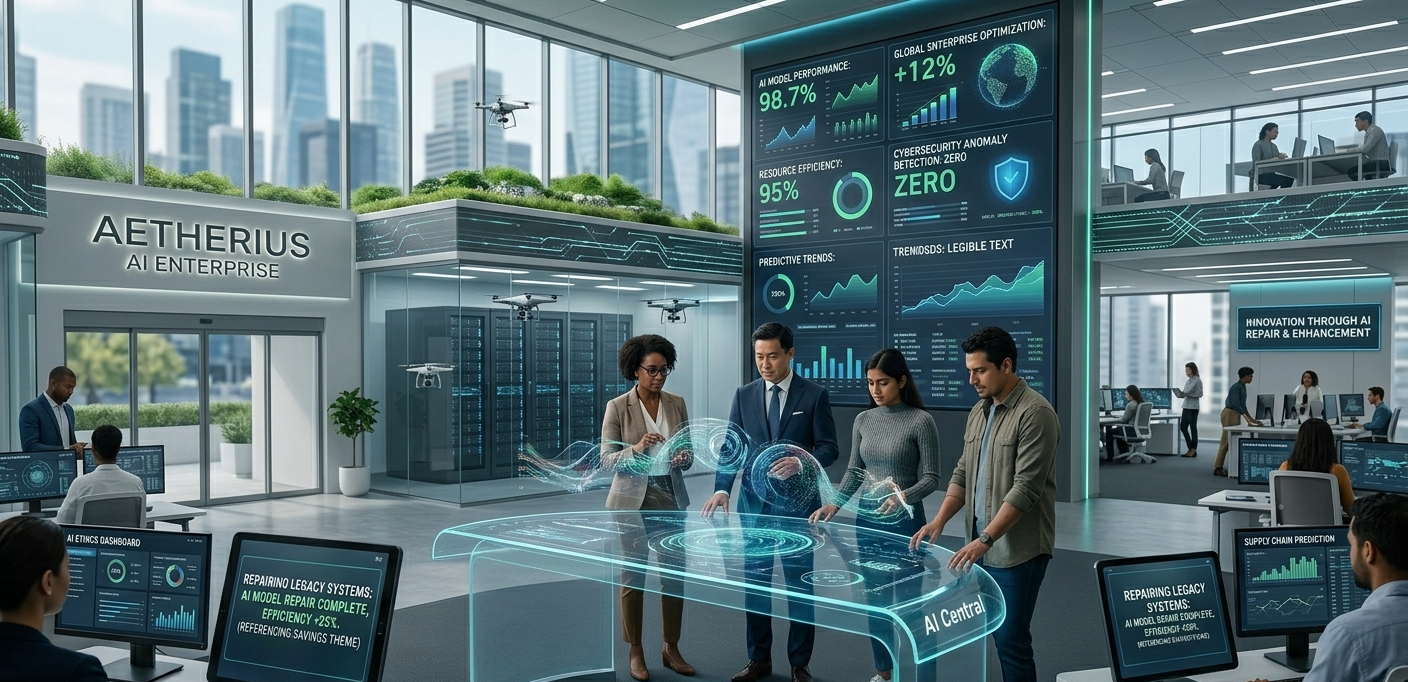
Artificial intelligence is a high-velocity engine transforming the backbone of global industry. What’s important for leadership teams to understand is that the shift from AI-enabled to AI-driven is already happening, sector by sector.
- Healthcare & Pharmaceuticals
AI is fundamentally shifting the medical landscape from reactive treatment to proactive, precision care. Machine learning is slashing drug discovery timelines by up to 50%, accelerating the journey from lab to clinical trials. Advanced algorithms are improving diagnostic accuracy, enabling earlier and more effective interventions. We are entering a new era where treatments are tailored to an individual’s genetic profile. Healthcare leaders are thus building AI-driven care ecosystems.
- Supply Chain & Logistics
In an era defined by global volatility, AI has become the backbone of operational stability. AI models anticipate disruptions before they impact operations. By synthesizing geopolitical and market data, organizations can make rapid, informed decisions. This shows that supply chains are evolving from linear processes to intelligent, self-adjusting networks.
III. Research & Development
Across industries like automotive and aerospace, AI is compressing innovation cycles dramatically. R&D timelines are being slashed by almost 50%, and specialized AI integration is reducing operational costs by up to 30%. Therefore , innovation is no longer constrained by time or cost, rather it is amplified by intelligence.
Time and Risk Are Being Rewritten
Whether it’s cutting lab time in half or shielding operations from global disruption, AI’s greatest value lies in one thing and that is the radical compression of time and risk. And this is precisely where the divide between AI-enabled and AI-driven becomes stark.
AI-enabled enterprises benefit from this shift but AI-driven enterprises capitalize on it at scale.
Reasons Most Enterprises Get Stuck
Despite massive investments, many organizations plateau at AI-enabled. Because becoming AI-driven is an enterprise transformation challenge. AI relies on continuous learning whereas traditional enterprises operate on fixed processes. AI is only as powerful as the data it learns from and this is why fragmented data leads to fragmented intelligence.
AI models without deep integration into workflows remain underutilized. Also, leadership hesitates to trust AI with important decisions, keeping it confined to advisory roles. The real question leaders must ask is how AI is shaping the ways in which their enterprise thinks, decides, and evolves because that’s the dividing line.
Engineering the Shift with PCPL
PCPL sees this transition as a structured journey. Moving from AI-enabled to AI-driven requires re-architecting the digital core. AI must sit at the heart of enterprise systems instead of as an external layer. From data collection to governance, every layer must be aligned for intelligence. AI should not generate reports but trigger actions. Systems must evolve with every interaction, every transaction, every signal. AI-driven, thus, means intelligently governed autonomy.
Many enterprises are still experimenting with AI- pilots, proofs of concept, and isolated use cases. But the leaders of tomorrow are doing something different. They are industrializing AI as in scaling models across business units, integrating intelligence into decision pipelines, and creating feedback loops that compound value over time. This is where transformation happens.
One of the biggest mistakes organizations make is treating AI as a technology initiative.
AI transformation is actually a business strategy decision, a leadership mindset shift, and a competitive positioning move. The CIO cannot drive this alone. Neither can the CTO architect it in isolation. It requires alignment from the boardroom to the backend.
In the coming years, enterprises will not compete on size, scale, or even talent alone. They will compete on how intelligently the enterprises operate. AI-enabled companies will improve and AI-driven companies will dominate.
Where Do You Stand?
This is the moment of clarity every leadership team needs. Are you using AI to assist your business or are you building a business that thinks, learns, and acts through AI? Because the gap between the two is not incremental.
It’s exponential.
At PCPL, we partner with enterprises to move beyond surface-level AI adoption. We help organizations transition from fragmented AI initiatives to unified intelligence ecosystems, integrate AI deeply into operational and strategic layers, and build systems that are adaptive and self-improving. Because in the end, AI is about building enterprises that are ready for the future before the future arrives.
References
https://mitsloan.mit.edu/ideas-made-to-matter/working-definitions/what-is-ai-driven-enterprise
https://www.subex.com/blog/why-enterprises-need-ai-driven-platforms/