
Agentic AI refers to a new class of artificial intelligence systems that don’t just respond to prompts, but act with intent. Unlike traditional AI models that require step-by-step human instructions, agentic AI systems can independently plan, make decisions, execute tasks, and adapt based on outcomes to achieve a defined goal.
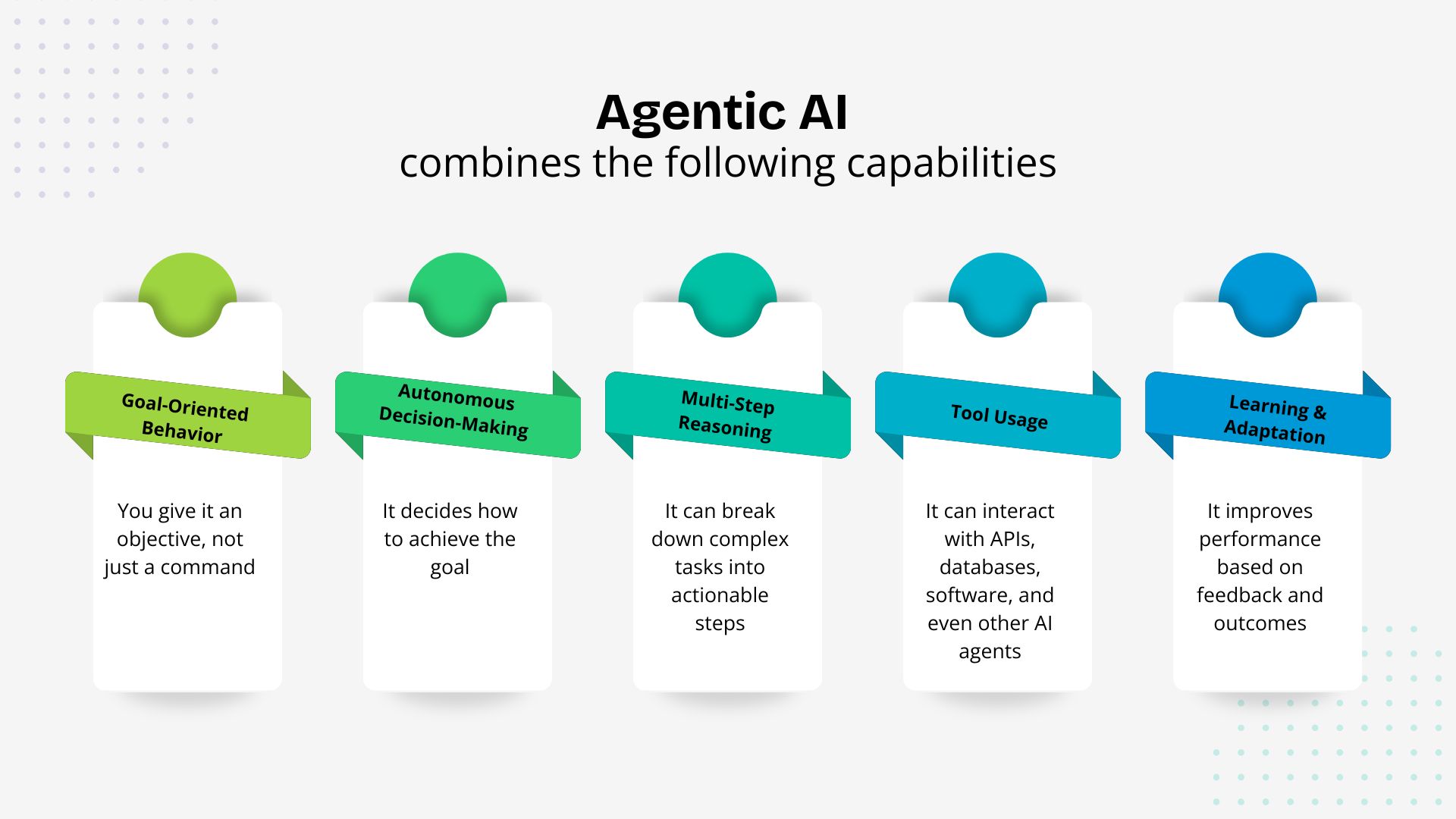
For example, instead of asking an AI to generate a report, you assign it a goal like analyze last quarter’s sales drop and recommend corrective actions. An agentic system can gather data, run analyses, identify patterns, and present insights without constant supervision.
Reasons Why Businesses Are Embracing Agentic AI
- Traditional automation handles repetitive tasks. Agentic AI handles dynamic workflows. This means fewer bottlenecks, less manual intervention, and faster execution.
- Teams can delegate entire workflows, research, analysis, customer interaction, reporting, to AI agents. This frees up human talent for strategy, creativity, and decision-making.
- Agentic systems think continuously. They monitor, respond, and optimize in real time.
- With the ability to synthesize large volumes of data and simulate outcomes, agentic AI enables faster, more informed decisions.
- Businesses can deploy multiple AI agents across functions like sales, operations, finance, customer support, thus creating an ecosystem of intelligent collaborators.
Several factors have converged to accelerate Agentic AI adoption in the current times and those are advances in large language models (LLMs), improved tool integration and APIs, better orchestration frameworks for multi-agent systems, and growing pressure on businesses to do more with less. Thus, organizations are moving from experimenting with AI to operationalizing intelligence.
Agentic AI Relying On Just Algorithms Is Problematic
Relying on algorithms alone for agentic AI is inherently limiting, and often risky. Algorithms operate on predefined logic, patterns, and historical data, which means they lack true contextual understanding, ethical judgment, and adaptability to unforeseen situations. In dynamic real-world environments, decisions are rarely black-and-white. They require nuance, intent interpretation, and value-based reasoning, areas where purely algorithmic systems fall short.
Without human oversight or broader cognitive frameworks, agentic AI can reinforce biases present in training data, make decisions that are technically correct but practically flawed, and fail to account for long-term consequences. Moreover, rigid algorithmic behavior struggles in ambiguous or novel scenarios, where flexibility and judgment are important. Thus, agentic AI that depends solely on algorithms risks becoming efficient, but not necessarily intelligent, responsible, or trustworthy.
Need For Agentic AI To Shift To Business Architecture
Most organizations today are experimenting with AI at a use-case level, chatbots here, automation there. But the real shift begins when AI moves from isolated tools to agentic systems that can independently plan, decide, and act across workflows. This is where the need to align with business architecture becomes important. Agentic AI doesn’t just execute tasks. It interacts with multiple systems, adapts to changing inputs, and drives outcomes. Without a well-defined business architecture, clear processes, data flows, ownership structures, and governance, these agents risk operating in silos, duplicating efforts, or even creating unintended conflicts.
Shifting to business architecture ensures that agentic AI is context-aware and outcome-driven. It helps organizations define where autonomy is appropriate, how decisions flow across functions, and how human oversight is embedded. More importantly, it connects AI initiatives directly to business goals, rather than treating them as experimental add-ons. The future of AI adoption is about embedding them into the very fabric of how a business is structured and operates.
Agentic AI represents a structural shift in how businesses design, operate, and evolve their architecture. Unlike traditional AI systems that respond to prompts or execute predefined workflows, agentic AI systems act autonomously, make context-aware decisions, and collaborate across functions.
This reshapes business architecture in the following ways
- Shift to Dynamic, Self-Orchestrating Systems- Traditional business architecture relies heavily on predefined processes and linear workflows. Agentic AI disrupts this by enabling systems that can dynamically orchestrate tasks based on real-time data, goals, and constraints. Instead of hardcoded process maps, organizations move toward adaptive workflows where AI agents decide how to achieve business outcomes.
- Decentralization of Decision-Making– Business architecture has long been hierarchical, with decision-making concentrated at specific levels. Agentic AI distributes intelligence across the system. Autonomous agents can make operational decisions at the edge, whether in supply chains, customer service, or finance, reducing latency and increasing responsiveness. This leads to a more decentralized, networked architecture.
- Shift to Outcome-Centric Design- Traditional enterprises are structured around functions likeHR, finance, operations. Agentic AI enables a shift toward outcome-driven architecture, where multiple agents collaborate across functions to achieve a shared goal that is optimize customer lifetime value or reduce delivery time. This blurs silos and redefines how capabilities are mapped.
- Continuous Learning and Evolution Built into Architecture– Business architectures have historically been redesigned periodically. With agentic AI, learning becomes continuous. Agents adapt based on feedback loops, data patterns, and environmental changes. This creates a living architecture that evolves in real time rather than through periodic transformation programs.
- Human-AI Collaboration as a Core Architectural Layer- Agentic AI introduces a new layer in business architecture that is structured human-AI collaboration. Instead of humans merely supervising systems, they co-create, guide, and intervene strategically. Roles shift from execution to oversight, exception handling, and value creation. Architecture must now account for trust, explainability, and governance at this interface.
- Redefinition of Roles and Capabilities- Capabilities are no longer just human or system-driven, they are hybrid. For example, a customer support capability may involve multiple AI agents handling queries autonomously, escalating only complex cases to humans. This requires rethinking capability models, ownership, and performance metrics.
- API-Driven, Modular, and Composable Architecture– Agentic AI succeeds in environments where systems are modular and interoperable. Businesses will need to shift toward API-first, composable architectures where agents can plug into different systems, access data, and trigger actions seamlessly. This accelerates innovation and scalability.
- Governance, Risk, and Ethical Architecture Becomes Central– With autonomy comes risk. Business architecture must embed governance frameworks that define how agents make decisions, what constraints they operate under, and how accountability is maintained. Ethical AI, auditability, and compliance become foundational architectural elements.
- Data Becomes a Live Input Stream– Agentic AI depends on continuous data flows rather than static datasets. This pushes organizations to rethink their data architecture, moving from batch processing to real-time pipelines that feed intelligent agents. Data quality, accessibility, and context become essential enablers.
- Acceleration of Business Agility and Innovation Cycles- Finally, agentic AI compresses the cycle from idea to execution. Businesses can experiment, iterate, and deploy changes faster because agents can simulate, test, and optimize processes autonomously. Architecture becomes a platform for rapid innovation rather than a constraint.
Conclusion
Agentic AI is undeniably powerful but without the scaffolding of business architecture, it remains an untamed force. Algorithms can drive efficiency, but they cannot define purpose, align priorities, or ensure coherence across an organization. That’s the role of business architecture. The real opportunity for enterprises is not just to deploy smarter AI agents, but to design an ecosystem where those agents operate with clarity, accountability, and alignment to business outcomes. This requires rethinking processes, redefining ownership, strengthening data foundations, and embedding governance at every layer.
In other words, AI success is an enterprise design challenge. Organizations that recognize this shift early will move beyond isolated AI wins to build truly intelligent, adaptive enterprises. Those that don’t risk creating fragmented systems that are powerful in parts, but ineffective as a whole. This is where enterprise architecture and consulting become important enablers. By bridging strategy, operations, and technology, they ensure that agentic AI is orchestrated, aligned and impactful.
References