
Almost 85% of business leaders now suffer from decision distress, frequently second-guessing their choices from the past year. The mental toll is so high that 70% of executives admit they would rather hand the reins to a robot than continue dealing with this overwhelming data landscape alone.
These figures point out to an important shift, that is the sheer volume of information has outpaced traditional human intuition. To bridge this gap, leadership is moving beyond old-school spreadsheets and toward Artificial Intelligence (AI). No longer just a futuristic novelty, AI is now the primary engine used to slice through complexity, refine decision quality, and forecast outcomes with clinical precision.
In the modern boardroom, AI has officially earned its seat, evolving from a back-office utility into a trusted strategic partner.
Mastering AI-Powered Automation
Automation has evolved from a corporate buzzword into an important strategic pillar for global organizations. However, the sheer volume of acronyms and methodologies can make finding the right fit feel like navigating a labyrinth. To help you cut through the noise, here are four essential facts about AI-powered decision-making and how it is redefining the modern enterprise.
AI-powered decision-making is a powerful trident composed of three integrated enablers- Digital Process Automation (DPA), Decision Automation, and Machine Learning.
Digital Process Automation is your foundation. DPA maps out entire end-to-end processes, using low-code functionality to significantly accelerate software development. It breaks down silos by integrating systems, giving employees a holistic view of their data. Machine Learning is your data engine. It analyzes historical data to provide accurate predictions and actionable recommendations. Decision Automation is your logic. It applies specific parameters, like insurance eligibility rules, to ensure outcomes are consistently accurate, objective, and lightning-fast.
In a disruptive market, speed is a competitive advantage. Traditional, massive off-the-shelf systems are often too rigid and force the business to adapt to the software, rather than the software adapting to the business. AI-powered automation flips this script. By combining AI with low-code platforms, Organizations put end-users in the driver’s seat by combining AI with low-code platforms. This empowers the workforce to become citizen developers, streamlining workflows because they, the ones doing the work, are the ones designing the solutions.
Stop losing months or years to bloated development cycles. AI-powered automation bridges the gap between Business and IT, ending the endless feedback loops that drain resources. It eliminates bottlenecks with integrated, cross-functional workflows that prevent data silos. Launch innovative applications in weeks, not years and increase your automation footprint without adding to technical debt or overhead costs.
AI-powered automation doesn’t have to replace your existing tools; it enhances them. It works in tandem with other popular technologies. While AI handles complex decisions, RPA acts as the digital hand to move data between systems. Data fabric automates data discovery and governance, ensuring the right information reaches the right person at the right time, regardless of where it’s stored.
Need for AI-Powered Decision-Making in Modern Business
Adapting to Artificial Intelligence has now become a survival mandate. AI-driven decision-making empowers organizations to transcend human limitations, enhancing efficiency, slashing operational costs, and achieving unprecedented accuracy.
To bridge the gap between raw technology and corporate leadership, specialized programs like an MBA with AI or an MBA in Information Technology are becoming essential. These credentials prepare the next generation of leaders to architect AI strategies that ensure their organizations remain at the forefront of innovation.
AI is Revolutionizing Corporate Strategy
Traditionally, business decisions were fueled by historical reports and human intuition. Today, AI has flipped the script by analyzing massive datasets with surgical precision in real-time. Professionals equipped with a Tech MBA or an AI-Integrated MBA act as the translators between data science and boardroom strategy. By leveraging AI-powered tools, these leaders provide their companies with a decisive competitive edge, turning gut feelings into data-backed certainties.
Predictive Analytics
Predictive analytics represents a fundamental shift in how companies manage risk. By processing both historical and live data, AI identifies emerging patterns and forecasts market trends. Whether it’s an MBA in Tech graduate integrating predictive models into finance or retail, the goal remains the same: minimizing exposure while seizing opportunities before the competition even sees them.
Sector-Specific Applications of AI
- Marketing- AI analyzes customer behavior to deliver hyper-personalized recommendations and targeted advertising. An MBA in Information Technology helps leaders master these engagement-boosting tools.
- Finance- From fraud detection to algorithmic trading, AI optimizes fiscal health. A Tech MBA provides the specialized knowledge to manage these complex financial models.
- Supply Chain- AI forecasts demand fluctuations and automates logistics, drastically reducing overhead. Leaders with an MBA in Technology are pivotal in streamlining these global operations.
Role of Automation in Strategic Growth
Automation is the engine of modern efficiency. By eliminating manual errors and accelerating processing speeds, AI-powered automation allows a business to scale without a linear increase in headcount.
The true value of automation lies in liberating human capital. When routine, repetitive tasks are handled by AI, professionals can focus on high-level creative and strategic initiatives. An MBA in Information Technology Management provides the roadmap for integrating these automated workflows into existing business models.
Industry examples include the following-
- Customer Service- 24/7 Chatbots handle high-volume inquiries, ensuring instant response times and higher satisfaction scores.
- Finance (RPA)- Robotic Process Automation manages data entry and compliance checks, ensuring error-free financial reporting.
- Human Resources- AI streamlines recruitment by screening resumes and managing workforce analytics, allowing HR teams to focus on talent development.
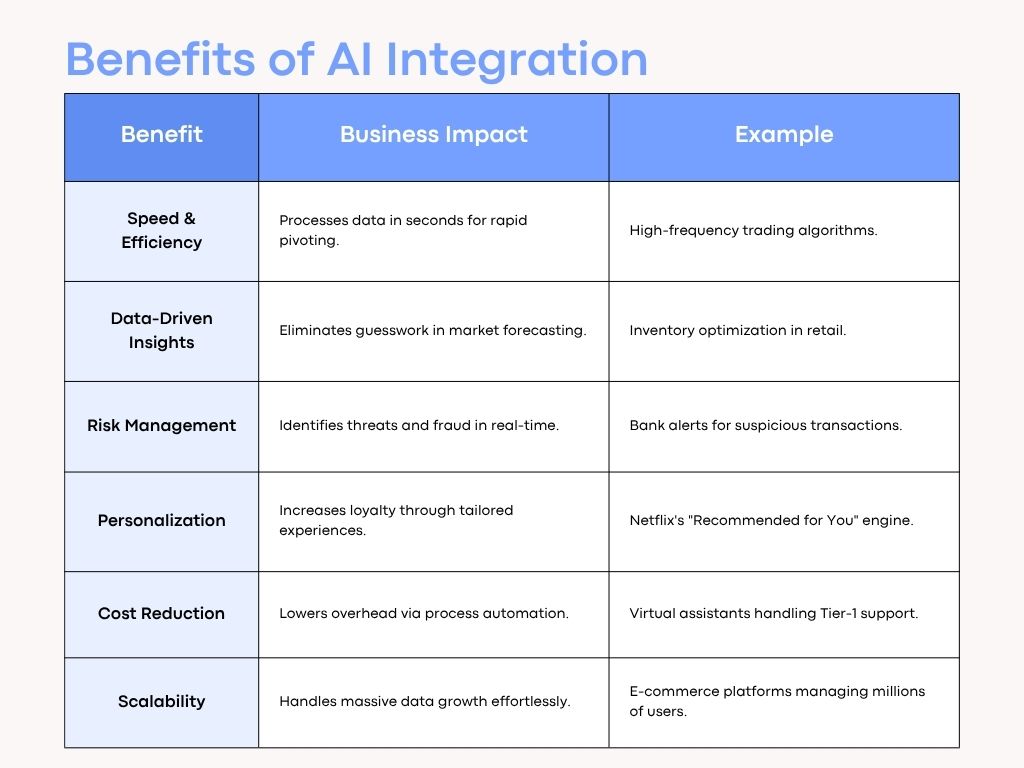
Benefits of AI Integration
Conclusion
As AI continues to redefine the industrial landscape, the demand for tech-literate leaders is surging and professionals holding an MBA in Technology or Information Technology Management are now the strategic architects of the future.
References
https://inrule.com/fast-facts-about-ai-powered-decision-making/
https://futurense.com/blog/ai-and-automation-impact-business-decision