

For mid-market companies, the AI automation scene is all about choosing the right execution model. Depending on your resources and goals, you generally have three strategic paths to consider.
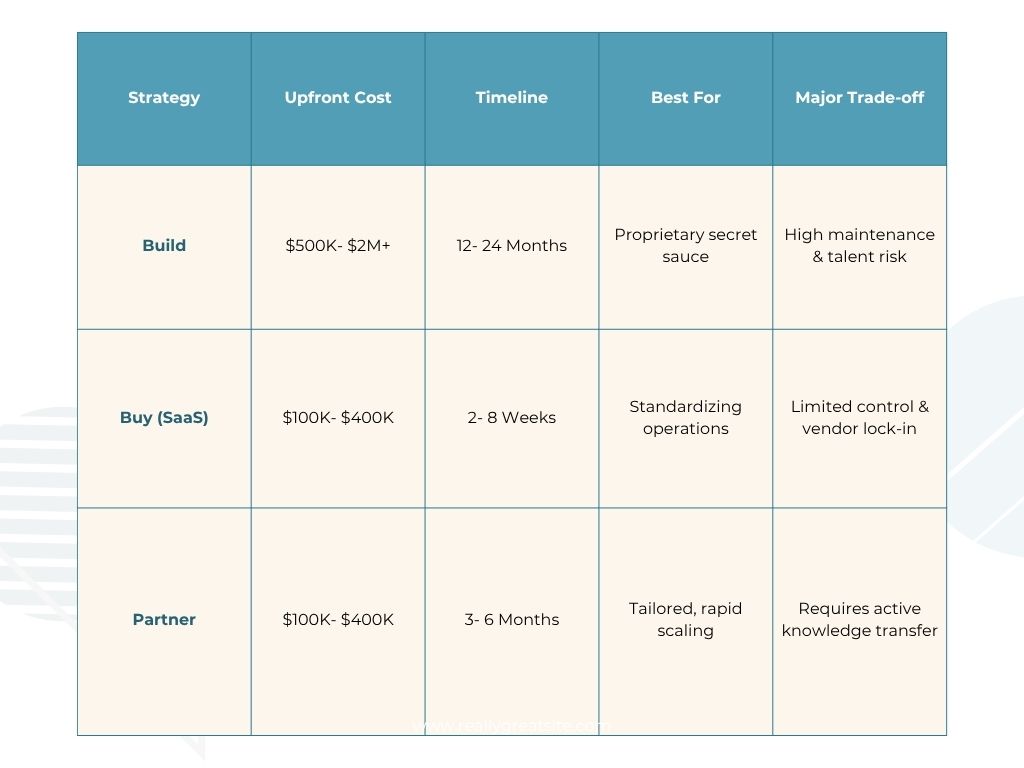
- Build (In-House Development)– This gives you total ownership and a bespoke competitive edge. However, it is an all-in commitment that requires a massive capital outlay and a dedicated team of engineers to keep it running.
- Buy (Off-the-Shelf SaaS)– This is the path of least resistance. It’s perfect for non-core functions (like HR or accounting) where speed is more important than uniqueness. The downside is that you’re using the same tools as your competitors.
- Partner (Expert-Led Implementation)– This bridges the gap. You get professional-grade results without the hiring headache. It’s flexible and fast, but you must ensure your internal team learns enough to manage the system once the experts leave.
Deciding how to scale your infrastructure is an important move. Whether you prioritize total control, speed-to-market, or specialized expertise, each path carries distinct trade-offs in capital and long-term agility.
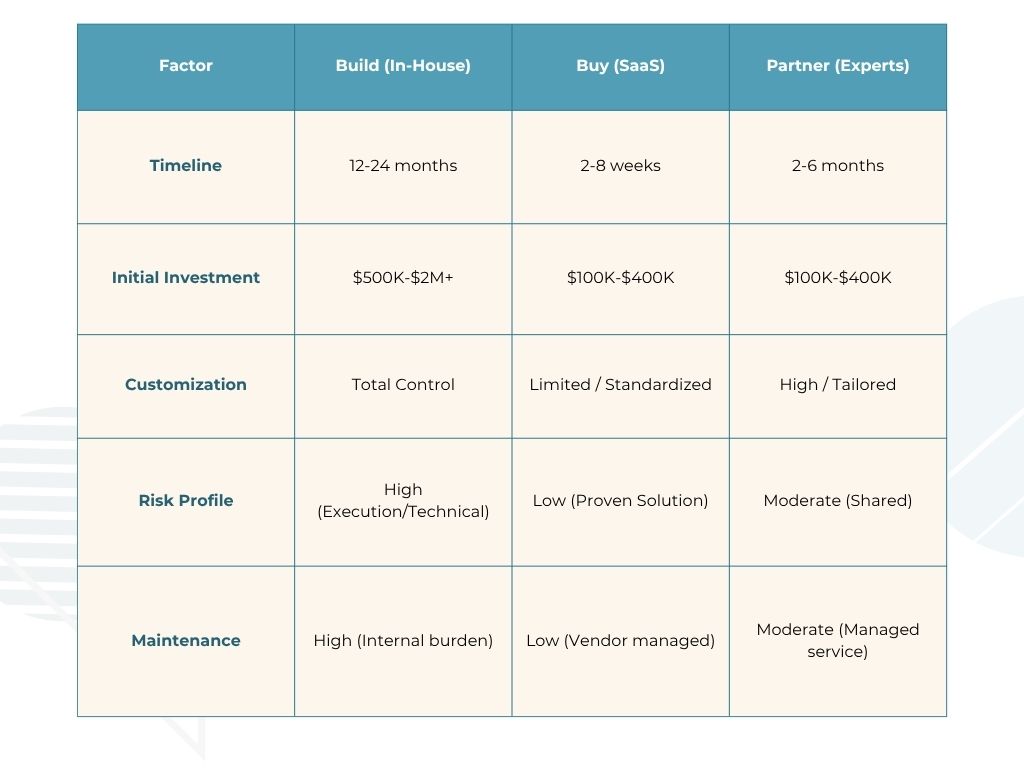
Market windows don’t stay open forever. While an in-house build offers the most control, it demands the most time, time your competitors are likely using to capture market share. Thus you need to evaluate your core competencies. If this solution isn’t your primary value proposition, Buy for speed or Partner for a balance of speed and customization.
The Build Approach
Choosing to build your own AI automation offers the ultimate advantage that is total control. You own the intellectual property and can tailor every workflow to your specific needs. However, the path to ownership is paved with significant risks and high overhead. While it promises customization, it often requires 6-12 months of trial and error, a timeframe during which more agile competitors might leapfrog you.
Corporate giants have proven that bespoke systems can yield massive results. Like for JPMorgan Chase, their COIN (Contract Intelligence) platform automates 360,000 hours of manual legal work annually by processing 12,000 contracts. They built a proprietary payroll system from the ground up to create a unique user experience that off-the-shelf software simply couldn’t replicate.
While inspiring, these examples are backed by massive capital. For mid-market firms, the financial reality is a much steeper climb.
Building internally is in reality a long-term financial commitment. Before you decide to go with this approach you need to take a look at the estimated costs for a mid-sized firm.
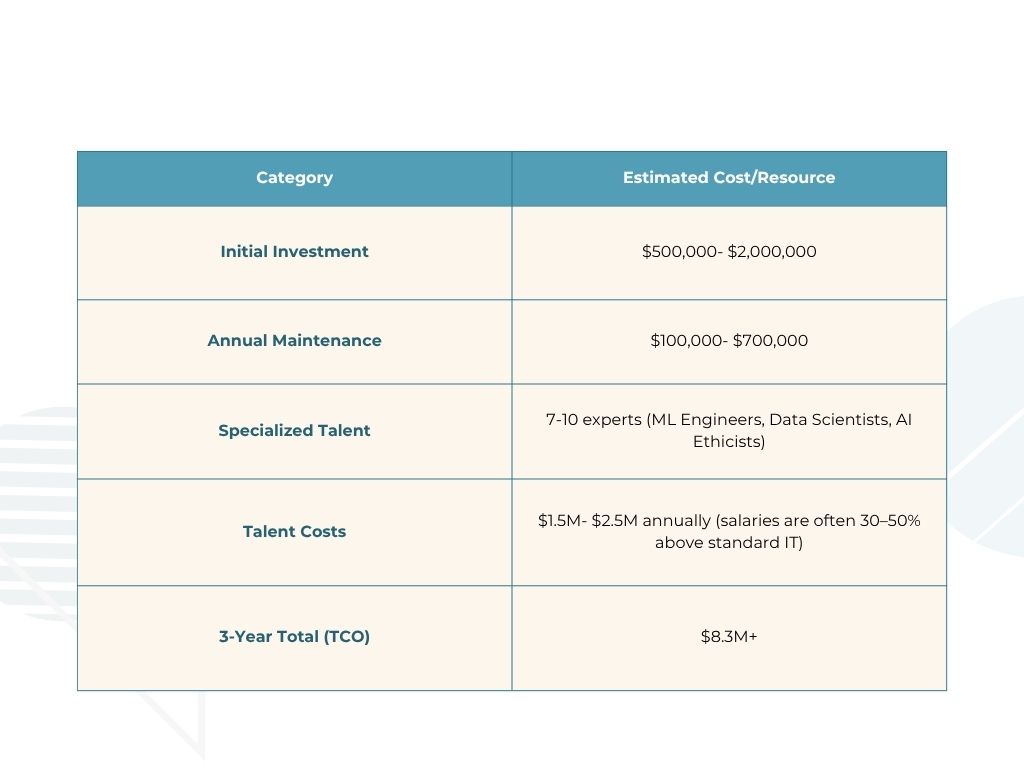
The hardest part in this approach is the maintenance. Internal tools often fail because they lack long-term support plans. When the original developer leaves, they often take essential knowledge, undocumented workflows, or API credentials with them. Ongoing success requires a dedicated commitment to MLOps, infrastructure scaling, and security compliance. Without this, your project risks joining the 85% of AI initiatives that fail to meet expectations.
Building in-house is a strategic bet. It only makes sense if AI is your core competitive edge and cannot be replicated by a vendor, you have the money to wait 18-24 months for a return on investment, and you can afford the opportunity cost of pulling your best engineers away from customer-facing products.
If speed and low maintenance are your priorities, a SaaS-based AI platform is likely the more sustainable path.
The Buy Approach
Choosing a pre-built SaaS platform fundamentally shifts your deployment strategy. Instead of a massive upfront investment of $500,000-$2,000,000 and a 6-12 month wait for results, SaaS models typically require a more manageable $100,000-$400,000 with a rapid deployment window of just 2-4 months. Financially, this moves the needle from heavy capital expenditure to predictable operating costs, with annual subscriptions usually settling between 15-20% of the initial spend.
While SaaS offers velocity and cost clarity, it often introduces constraints on customization. These platforms are designed to excel at partial fit scenarios, standardizing routine operations like HR workflows, IT support, and financial tasks. However, if your competitive edge relies on proprietary algorithms or unique internal processes, a generic platform may feel restrictive.
For 90% of enterprise use cases, buying an AI agent platform is the most feasible choice. The remaining 10% is where the real risk lies. Beyond the subscription fees, organizations must weigh the impact of vendor lock-in. Depending on a third party means your operations are vulnerable to their pricing shifts, technology pivots, or financial stability. Further, because the vendor retains the intellectual property (IP), including model parameters and prompts, your team isn’t building the internal AI expertise that remains portable across providers.
Thus SaaS platforms often result in a 56% lower total cost of ownership (TCO) over three years compared to in-house builds. Don’t ignore expenses and remember that integration costs can be 40% higher, and maintaining SOC2 compliance or data sovereignty requires dedicated resources. The most successful enterprises treat SaaS as a utility layer for standardized tasks while keeping their most strategic, differentiating AI processes in-house.
Next, we’ll explore how a Partner model offers a balanced middle ground.
The Partner Approach
Think of this as the sweet spot of AI adoption. Rather than building from scratch or settling for a generic off-the-shelf tool, partnering with external experts offers a high-velocity middle ground. With implementation costs typically ranging from $100,000 to $400,000, you gain immediate access to specialized talent without the overhead of a full-scale hiring cycle.
The primary advantage is risk mitigation. Gartner reports an 85% failure rate for AI projects, largely because internal teams lose months to steep learning curves. AI is not a process in and of itself, it’s part of the daily work. We mould it into CRMs, into existing workflows, and quantify the value before scaling. You bypass the trial-and-error phase and jump straight to value by using seasoned pros.
The financial math often favors the partner model over time. While an internal build usually demands 35% of the initial cost for annual maintenance, partnered solutions typically require only 15-20%.
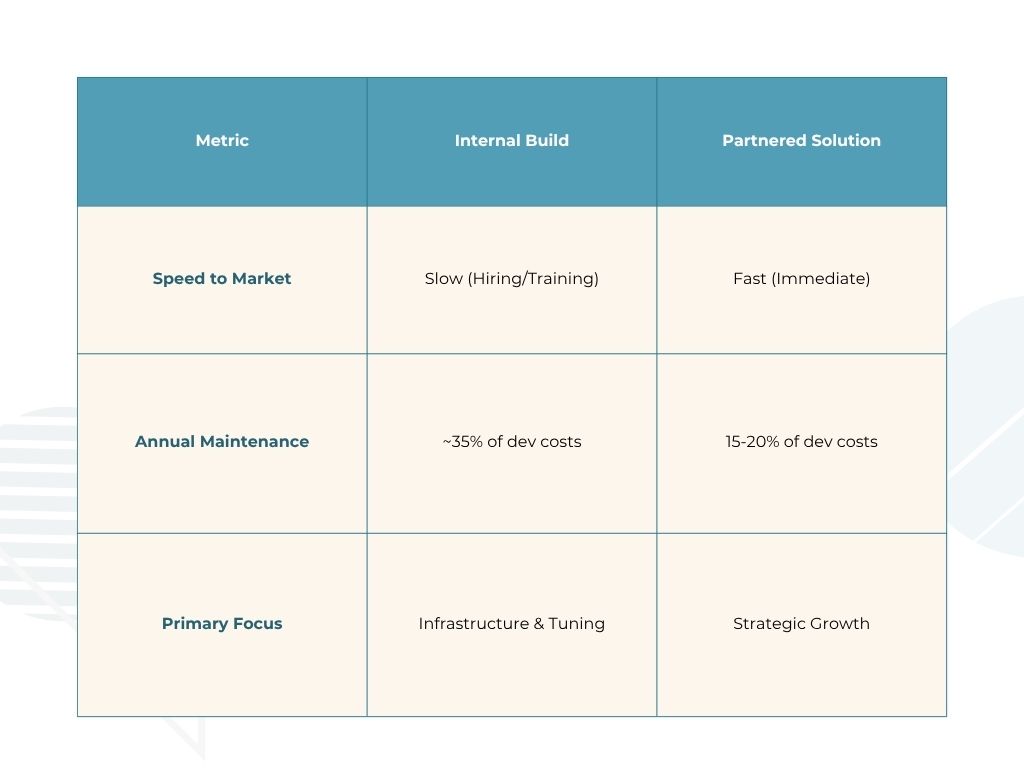
To succeed, focus on knowledge transfer. Avoid consultants who hand over a system your team can’t explain or manage. The gold standard of partnership is collaborative, and your internal staff should be side-by-side with the experts, documenting decisions and learning to take the reins.
Make Use of The Hybrid Advantage
Interestingly, 63% of high-performing companies use a hybrid strategy. They partner for specialized capabilities while keeping their core proprietary tech in-house. In this model, consultants are builders of your internal capability, ensuring your team is ready for the future.
Weighing Your Options
Choosing an AI strategy is a high-stakes resource allocation. To help you deal with the trade-offs, here is a side-by-side breakdown of the three primary paths to automation.
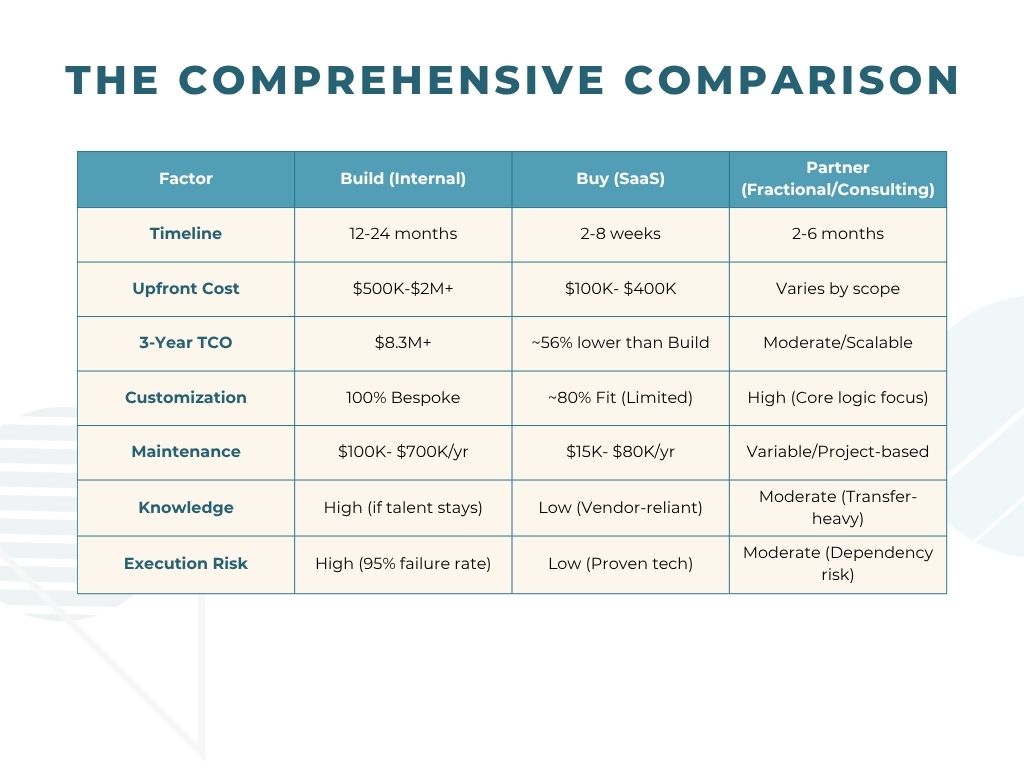
The most significant investment in a Build strategy is the opportunity cost. While your team spends 18 months navigating the 95% failure rate of internal AI projects, your competitors are already iterating with off-the-shelf tools.
Industry data suggests that building in-house is only justifiable when the AI itself is the primary reason customers choose you over everyone else. For everything else, the Hybrid Model is winning- 63% of successful firms buy a robust foundation and only build the proprietary last mile that provides their competitive edge.
- Build– If the AI is your core product and provides a unique, defensible moat.
- Buy– If you need a utility-based solution (e.g., CRM automation) and need it yesterday.
- Partner– If you need a tailored integration and expert speed without the overhead of a massive internal department.
For mid-sized companies, partnering often offers the agility of SaaS with the strategic customization of an internal build.
Choosing the right AI strategy requires choosing the one that actually moves the needle for your specific business. Whether you invest $8.3M+ to build a proprietary edge, save 56% by buying off-the-shelf, or partner to bypass a two-year development cycle, your decision should be based on where you want to win.
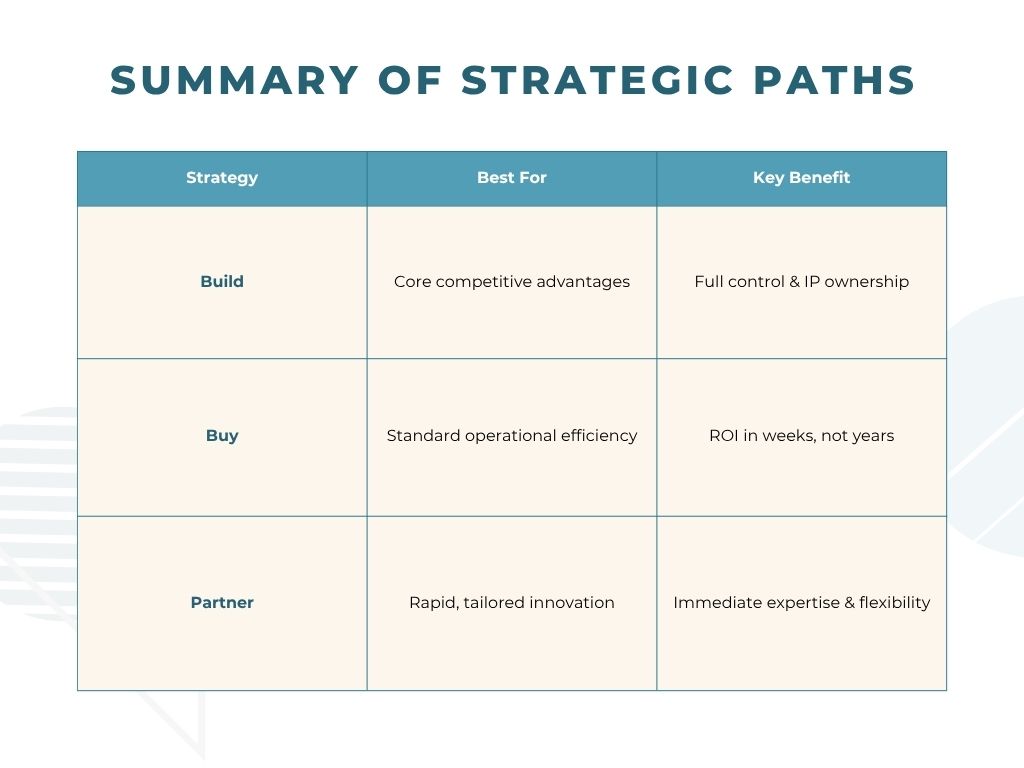
The cost of inaction can be higher than the cost of a mistake. While you weigh the options, the market is moving, and the gap between you and your competitors is widening. Calculate your true three-year TCO, including talent and maintenance. Categorize if AI is a utility (Buy), a differentiator (Build), or a new muscle you need to grow (Partner). Finally, launch a proof-of-concept this quarter to see what sticks.
PCPL focuses on capability transfer, ensuring that whatever you build with us stays with you as a long-term asset. Let’s identify the path that fits your budget and timeline today so you can lead tomorrow.
References