
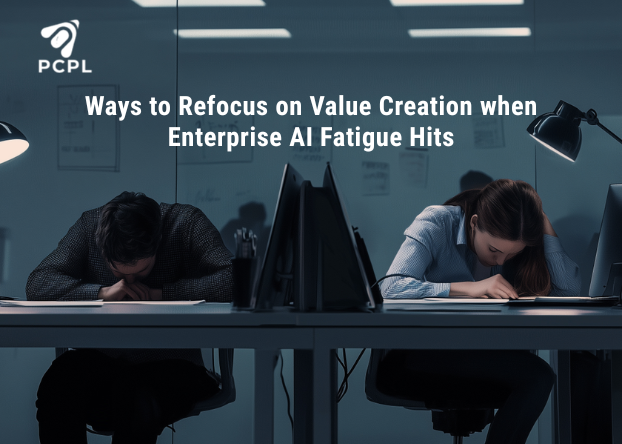
Ways to Refocus on Value Creation when Enterprise AI Fatigue Hits
Between mandatory AI upskilling bootcamps and the relentless flood of new workplace tools, Artificial Intelligence has gone from a futuristic promise to a daily exhaustion. This constant pressure to adapt is fueling a phenomenon known as AI fatigue, where the race to keep pace with technology leaves employees feeling more drained than empowered.
The strain is visible on both sides of the desk. According to S&P Global Market Intelligence, the number of companies abandoning the majority of their AI initiatives skyrocketed from 17% in 2024 to 42% in 2025. A study by Quantum Workplace found that employees who use AI frequently report 45% higher burnout rates than those who rarely engage with it.
AI fatigue is a productivity killer that erodes morale and drives high-performing talent toward the exit. To stop the drain, we need to understand the root causes and implement strategies to regain control before burnout becomes the new baseline.
When organizations shift the conversation back to value creation rather than technology adoption, AI starts making sense again.
Ways in Which Enterprises Can Refocus Their Efforts
- Shift the Conversation from AI to Business Outcomes
One of the biggest mistakes organizations make is treating AI as the end goal.
AI should not be implemented because it is trending. It should exist to solve a specific business problem, reducing operational cost, improving decision-making speed, enhancing customer experience, or unlocking new revenue streams.
Instead of asking where AI can be used, start asking where the business is losing time, money, or opportunity. AI becomes meaningful when it is tied to measurable outcomes, not technological ambition.
- Fix the Process Before Adding Intelligence
Many enterprises try to apply AI on top of inefficient or fragmented processes. When workflows are poorly defined, automation only amplifies confusion. Before implementing AI, organizations should map existing processes, identify inefficiencies, remove redundant steps, and standardize data flows. Only then should intelligence be introduced. AI performs best when it operates on structured, optimized processes.
- Move Beyond Pilots to Scalable Solutions
Another contributor to AI fatigue is the endless cycle of proof-of-concept projects that never scale. Organizations experiment with multiple AI tools but fail to integrate them into core operations. This creates fragmented initiatives that show promise but deliver little impact.
Enterprises should focus on building scalable AI architecture, integrating AI into existing systems, and aligning initiatives with long-term digital strategy. AI must become part of the operational backbone, not just an innovation experiment.
- Prioritize High-Impact Use Cases
Not every business function needs AI. Instead of spreading resources across dozens of initiatives, enterprises should prioritize a few high-impact areas where AI can create meaningful transformation.
Examples include intelligent document processing, predictive maintenance, invoice and contract verification, customer service automation, and decision intelligence platforms. Focusing on the right problems ensures faster ROI and prevents initiative overload.
- Empower Employees Instead of Replacing Them
Another source of AI resistance comes from employee uncertainty. When AI is positioned as a replacement technology, teams may disengage or resist adoption.
However, when AI is framed as a productivity partner, adoption improves dramatically. Organizations should focus on AI-assisted decision-making, AI-powered workflow support, and AI tools that remove repetitive work. The goal is to enhance human capability.
- Strengthen Data Foundations
AI systems are good only if the data they learn from is good. Many organizations struggle because their data ecosystems are fragmented, inconsistent, or poorly governed. To create real value, enterprises must invest in data quality frameworks, unified data platforms, governance and transparency, and real-time data accessibility. Without a strong data foundation, even the most advanced AI models will struggle to deliver meaningful results.
- Align AI with Organizational Strategy
AI initiatives often fail because they are treated as isolated technology projects. Instead, AI should be aligned with strategic business priorities such as operational efficiency, market expansion, product innovation, and customer experience transformation. When AI becomes part of strategic decision-making, its value becomes clearer across the organization.
The Path Forward
AI fatigue is not a sign that AI has failed. It is a signal that organizations need to shift from experimentation to purposeful implementation. The enterprises that will succeed in the coming decade are not those that deploy the most AI tools. They will be the ones that align intelligence with value creation, operational clarity, and scalable systems.
PCPL believes that technology should serve business outcomes and not the other way around. The future of enterprise AI lies in thoughtful implementation, process alignment, and measurable impact. When organizations refocus on value creation, AI stops feeling like a burden—and starts becoming a competitive advantage.
Moving past the initial AI excitement requires a steady hand and a clear strategy. We’re here to help you deal through the complexities of the next phase, ensuring your AI products are robust, impactful, and ready to scale. Connect with us to get started.
References
https://theblueowls.com/blog/ai-fatigue-heres-how-to-stay-focused-on-real-business-outcomes/
https://8thlight.com/insights/overcoming-ai-fatigue