
The gap between application demand and IT capacity continues to widen due to resource constraints and long development cycles. Citizen development addresses this by empowering non-technical users to build their own solutions.
Integrating AI further accelerates this shift, automating routine tasks and providing real-time error detection. Organizations can clear IT backlogs, optimize workflows, and create a more collaborative, agile environment by democratizing development with AI-driven insights.
The Evolution of Citizen Development Through AI
Artificial Intelligence is transforming citizen development from a manual effort into a streamlined, high-impact process. Organizations empower non-technical users to build sophisticated tools with professional-grade precision by integrating AI into low-code and no-code platforms.
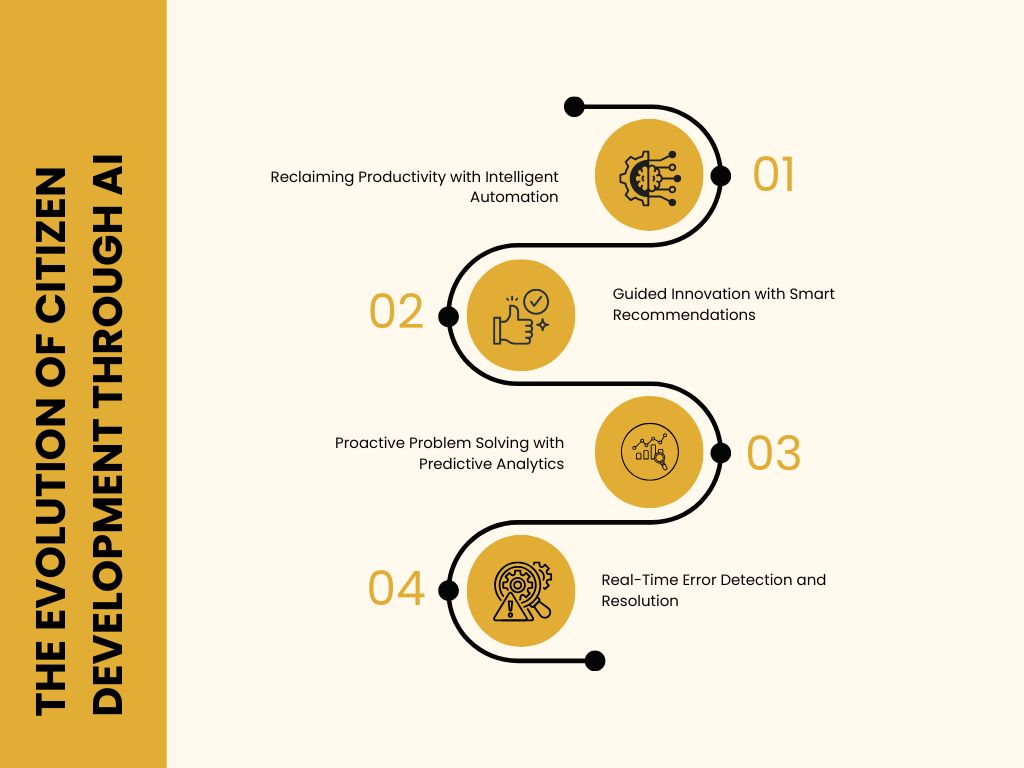
- Reclaiming Productivity with Intelligent Automation
Manual, repetitive tasks are often the primary bottleneck in software development. AI reduces this burden by automating routine administrative functions, allowing citizen developers to prioritize logic and design over busywork. AI manages under-the-hood tasks like configuring approval chains, mapping user roles, and setting trigger-based notifications. AI eliminates the risk of manual error by removing human intervention from routine steps and ensures a standardized approach across all projects, significantly accelerating time-to-market.
- Guided Innovation with Smart Recommendations
AI acts as a digital consultant, using historical data and user behavior to provide context-aware suggestions. Instead of starting from a blank canvas, developers receive tailored guidance to optimize their builds. Based on the project’s goal, AI can suggest the most effective templates and UI structures. If a user is building an expense management tool, for example, the AI might suggest pre-verified logic for routing requests according to existing corporate policy, ensuring every application is both functional and compliant.
- Proactive Problem Solving with Predictive Analytics
The true power of AI lies in its foresight. Predictive analytics allows users to see around corners, identifying potential hurdles before they impact the end-user. AI analyzes proposed workflows to flag stages where delays are likely to occur, offering adjustments in real-time. AI can predict how an application will perform under stress by simulating high-traffic scenarios and recommend necessary infrastructure adjustments to maintain a seamless user experience.
- Real-Time Error Detection and Resolution
For those without a coding background, technical errors can be a major barrier. AI serves as an integrated quality assurance (QA) expert, providing a safety net throughout the development lifecycle. AI monitors the build process to identify broken integrations, misaligned data fields, or incomplete logic steps as they happen. Beyond merely flagging errors, the system provides actionable solutions to fix them. This real-time support minimizes the need for post-launch debugging and ensures that applications are production-ready from day one.
Main AI Features in Citizen Development Platforms
AI-enhanced citizen development platforms use sophisticated automation and natural language processing to bridge the gap between business logic and technical execution. These features empower non-technical users to build robust, scalable applications with minimal friction.
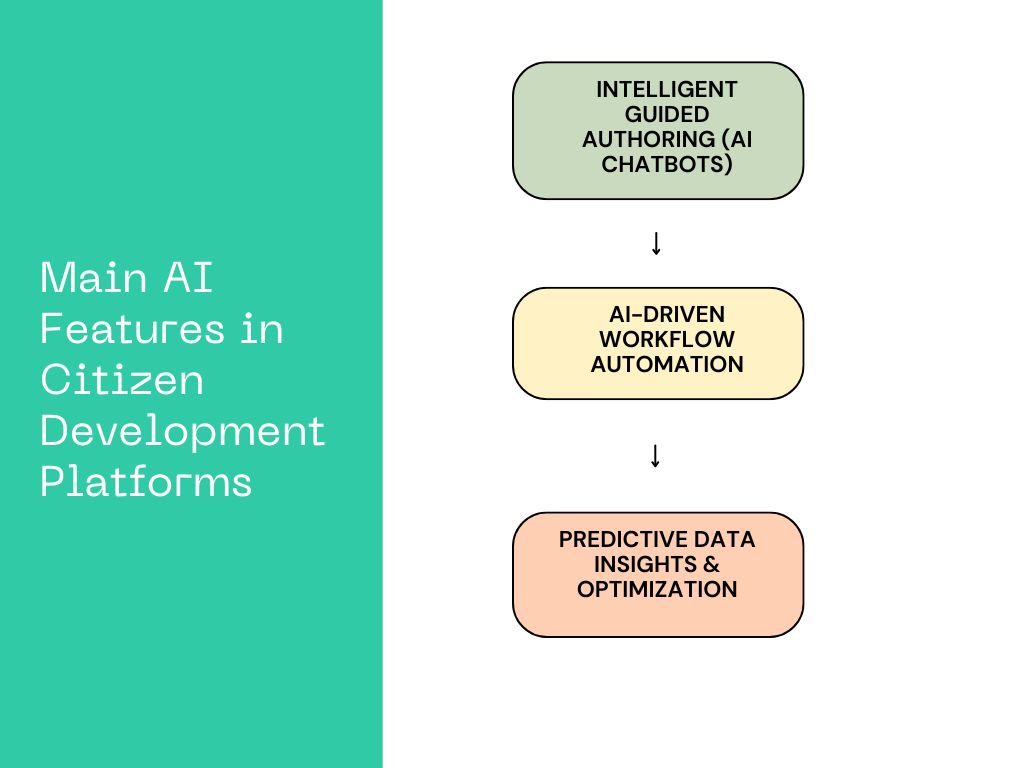
- Intelligent Guided Authoring (AI Chatbots)
AI-powered assistants act as real-time mentors, transforming the development experience from a technical hurdle into a guided conversation.
- Real-Time Troubleshooting– Provides instant answers to how-to questions, reducing the dependency on IT support tickets.
- Contextual Guidance– Offers step-by-step instructions for complex tasks, such as API integration or data mapping, based on the user’s current project state.
- Template Discovery– Recommends pre-built frameworks that align with the user’s stated goals, significantly accelerating the initial build phase.
- AI-Driven Workflow Automation
Beyond simple if-this-then-that logic, AI automates the orchestration of complex business processes, ensuring consistency and speed.
- Dynamic Task Routing– Automatically assigns tasks and routes approvals based on real-time data and organizational hierarchy.
- Error Reduction– Eliminates the manual data entry points where human error is most likely to occur.
- Operational Compliance– Ensures all automated actions adhere to predefined business rules and regulatory requirements, providing an inherent layer of governance.
- Predictive Data Insights & Optimization
AI tools continuously monitor the health and usage of applications to provide a roadmap for iterative improvement.
- Performance Bottleneck Identification– Pinpoints exactly where users are dropping off or where a process is stalling.
- Usage Analytics– Identifies high-value features versus underutilized ones, allowing developers to focus their efforts on what truly impacts the business.
- Proactive Risk Management– Detects anomalies in data or workflow patterns that could indicate security risks or process inefficiencies before they become critical issues.
Advantages of AI-Driven Citizen Development
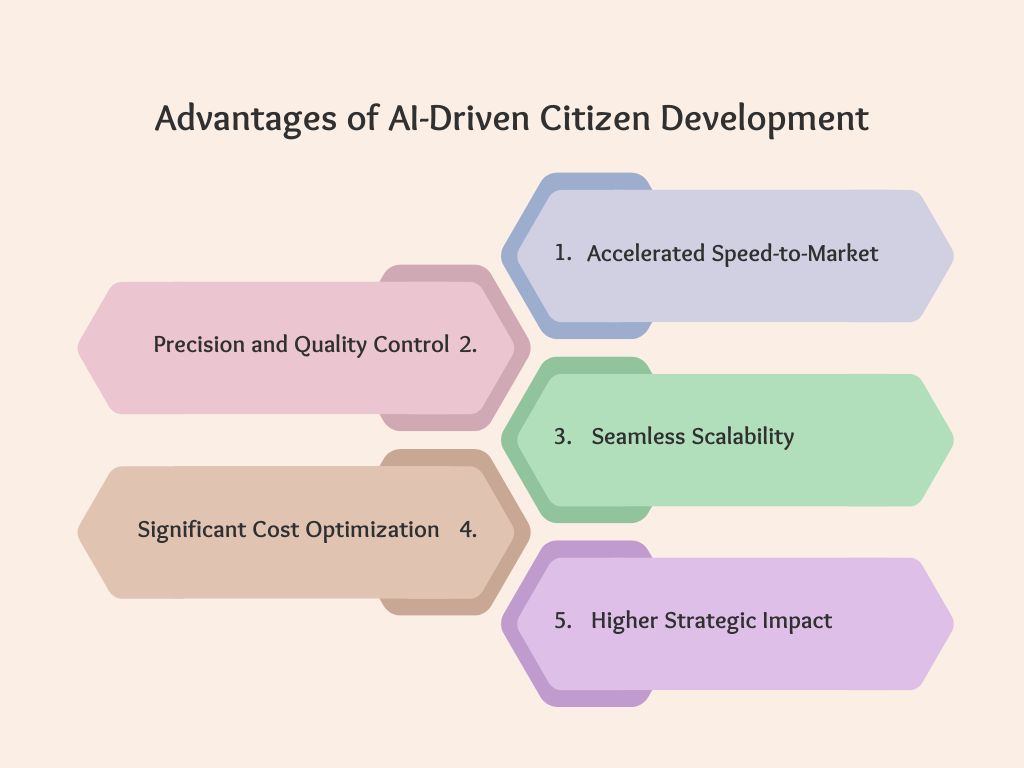
Accelerated Speed-to-Market
AI acts as a force multiplier for efficiency. AI compresses development timelines from days to hours by automating repetitive tasks such as mapping data fields, configuring approval workflows, or generating UI templates. These intelligent suggestions allow organizations to turn quickly, meeting urgent business demands and shortening the feedback loop between an idea and a functional application.
Precision and Quality Control
Manual entry and logic errors are the primary causes of application failure. AI mitigates these risks by providing real-time validation and predictive debugging. AI identifies format mismatches or missing logic before the app goes live. Built-in guardrails ensure that citizen-developed tools are robust and dependable, significantly reducing the technical debt and maintenance burden usually associated with non-pro developers.
Seamless Scalability
Growth often introduces complexity that can overwhelm simple applications. AI-driven platforms future-proof these tools by monitoring usage patterns and suggesting performance tweaks, automatically adjusting workflows to handle increased data loads or user traffic, and ensuring that as the business expands, the underlying applications adapt without requiring a total manual overhaul.
Significant Cost Optimization
Integrating AI delivers immediate and long-term financial benefits by democratizing the development process. Expensive technical resources are no longer bogged down by minor workflow tweaks or basic app requests. Automation slashes the cost per app, allowing companies to build more solutions with the same budget. Fewer bugs and more efficient resource allocation mean lower ongoing operational expenses.
Higher Strategic Impact
Perhaps the greatest benefit is the shift in human focus. When AI handles the grunt work of app creation, it unlocks a two-fold advantage. IT Teams can move away from ticket-tending and focus on high-level architecture, security, and digital transformation. Business Users can focus on innovation and customer experience, using their domain expertise to solve problems directly rather than waiting for a developer to understand their needs.
Core Trends Reshaping This Landscape
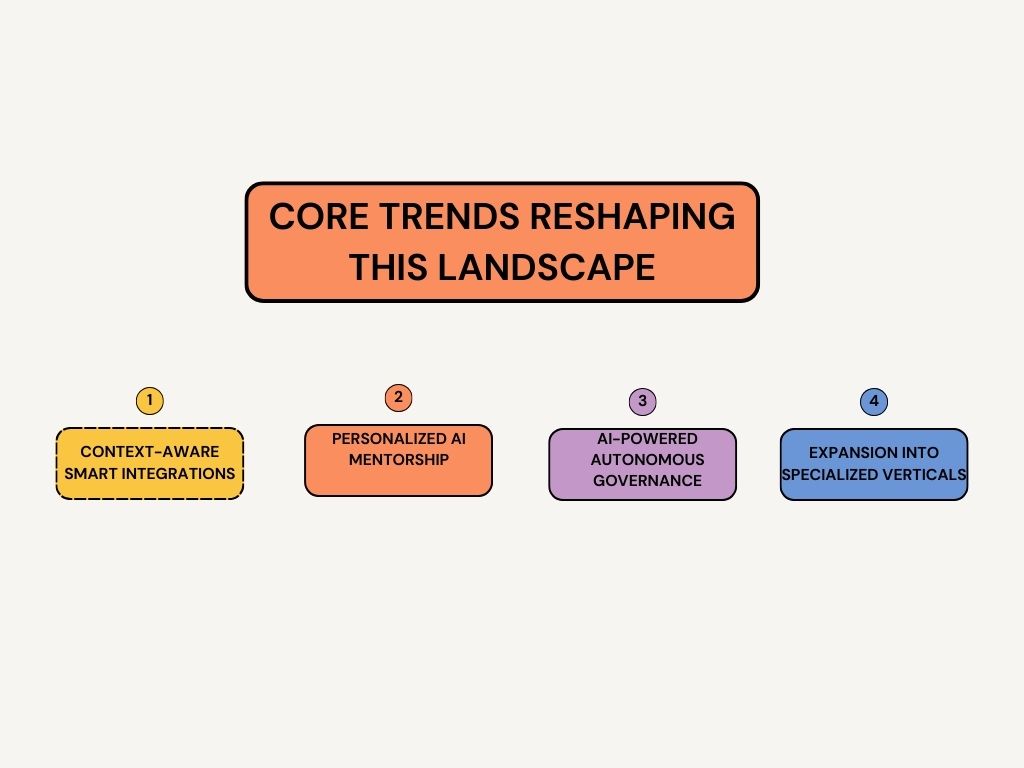
- Context-Aware Smart Integrations
Future platforms will transition from passive tools to active co-pilots. Rather than just providing a canvas, AI will use predictive modeling to understand a user’s intent. Platforms will suggest industry-specific templates and data schemas based on the user’s initial inputs. Complex technical hurdles like API mapping and data pipeline configuration will be handled by AI, allowing non-technical users to focus entirely on the business logic. A significantly lower barrier to entry and faster time-to-value for internal projects will be achieved.
- Personalized AI Mentorship
The one-size-fits-all documentation approach is being replaced by hyper-personalized learning paths. AI-driven training tools will act as real-time tutors. The AI identifies skill gaps and offers targeted tutorials by monitoring how a user interacts with the platform. Instead of generic error messages, AI provides instant, conversational feedback to help users refine their logic and fix bugs as they build. A continuous upskilling cycle that turns beginners into power users without formal IT training gets initiated.
- AI-Powered Autonomous Governance
To combat the risks of Shadow IT, future citizen development will feature built-in, intelligent guardrails. Security will no longer be a manual audit process but an automated layer of the development lifecycle. AI will automatically flag workflows that violate data privacy laws (like GDPR) or internal security protocols before the app is even deployed. Machine learning algorithms will monitor developed apps in real-time to identify unusual data access patterns or potential vulnerabilities. Organizations can empower employees to innovate freely, knowing that the platform provides a secure-by-design environment.
- Expansion into Specialized Verticals
AI-driven citizen development is moving out of the back office and into the core operations of diverse industries as listed below-
- Healthcare- Front-line staff can build HIPAA-compliant patient tracking tools or diagnostic assistants.
- Manufacturing- Floor managers can develop predictive maintenance apps that sync with IoT sensors on the fly.
- Education- Educators can design custom learning management modules that adapt to student performance data.
- Outcome- A democratization of innovation where those closest to the problem have the tools to build the solution.
References
https://www.hbs.net/blog/remove-it-bottlenecks-embrace-the-citizen-development-era
https://kissflow.com/citizen-development/ai-in-citizen-development/