
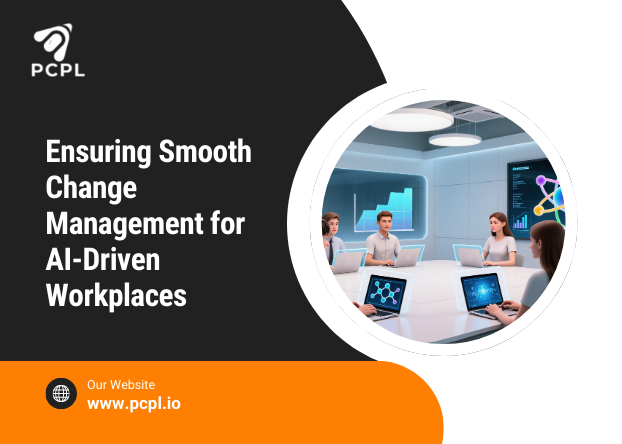
Change management is the structured method that helps individuals, teams, and organizations transition from their current state to a desired future state. Traditionally, it focused on process changes, system upgrades, or organizational restructuring. Today, however, change management has taken on a far more complex role with the rise of AI-driven workplaces.
AI fundamentally alters how decisions are made, how work is executed, and how employees interact with systems. From intelligent automation and predictive analytics to AI-powered copilots and agentic workflows, the pace and depth of change are unprecedented. Without a thoughtful change management strategy, even the most advanced AI initiatives risk resistance, underutilization, or outright failure.
The Nature of AI-Driven Change
Unlike traditional digital transformations, AI-driven change impacts on the following
- Decision-making authority (machines augment or influence human decisions)
- Roles and responsibilities (tasks evolve rather than disappear)
- Skills and capabilities (continuous learning becomes mandatory)
- Organizational culture (trust in AI becomes essential)
This makes AI adoption as much a human transformation as a technological one. Employees often fear job displacement, loss of control, or increased performance pressure. Leaders, on the other hand, struggle with governance, ethical considerations, and accountability.
Pillars of Change Management for AI-Driven Workplaces
- Establishing a Clear AI Vision and Narrative
One of the biggest reasons AI initiatives face resistance is ambiguity. Employees need clarity on why AI is being introduced, what problems it will solve, and how it will support, and not replace them.
A strong narrative should frame AI as a co-intelligence partner, enhancing human capabilities rather than eliminating roles. When people understand the “why,” they are far more willing to engage with the “how.”
- Leadership Alignment and Ownership
AI-driven change cannot be delegated solely to IT teams. Leadership must actively sponsor and model the change.
This includes aligning business leaders, HR, IT, and operations on AI priorities, demonstrating confidence in AI-backed decisions, communicating consistently and transparently.
When leaders visibly adopt AI tools themselves, it sends a strong signal that AI is not experimental but strategic.
- Redefining Roles, Not Just Automating Tasks
A common misconception is that AI adoption is about automation alone. In reality, it is about role evolution.
Change management must proactively address how job roles will shift, which tasks will be augmented by AI, and what new responsibilities will emerge.
Organizations that focus on job redesign rather than job reduction build trust and reduce resistance. Employees are more open to change when they see a future for themselves in the AI-enabled workplace.
- Skill Development and Continuous Learning
AI-driven workplaces demand new skills like that of data literacy, critical thinking, AI collaboration, and ethical judgment.
Effective change management includes skill gap assessments, role-based learning paths, hands-on AI adoption workshops, ongoing upskilling, not one-time training.
Learning should be positioned as an investment in employees, reinforcing the message that AI success depends on human expertise.
- Building Trust Through Governance and Ethics
Trust is central to AI adoption. Employees need assurance that AI systems are fair, explainable, and accountable.
Change management must integrate clear AI governance frameworks, transparent decision logic where possible, defined escalation and override mechanisms, ethical AI principles aligned with organizational values, and when people trust the system, they are far more likely to rely on it.
- Pilots, Feedback Loops, and Iterative Rollouts
AI transformation should not be a “big bang” rollout. Incremental pilots allow organizations to test real-world impact, collect employee feedback, refine workflows and controls, and demonstrate quick wins.
Involving employees early and incorporating their feedback turns them into co-creators of change, rather than passive recipients.
- Measuring Adoption, Not Just Implementation
Success metrics for AI-driven change go beyond deployment timelines or cost savings.
Organizations should track adoption rates. employee confidence in AI tools, decision quality improvements, and productivity and experience metrics.
Change management is complete only when AI becomes a natural part of daily work, not an imposed layer.
Pitfalls to Avoid
Even well-intentioned AI initiatives can fail due to overemphasis on technology over people, lack of communication or inconsistent messaging, ignoring middle management, who play an important adoption role, and treating change management as a one-time phase instead of an ongoing process.
Avoiding these requires a structured, experience-led approach to transformation.
PCPL Enables Seamless AI-Driven Change
AI-driven workplaces represent the future of enterprise operations, but success depends on how well organizations manage the human side of this transformation.
PCPL believes that AI transformation is about co-intelligence, where human judgment and AI capabilities work together. Our approach to change management combines strategic consulting, process redesign, technology integration, and people enablement.
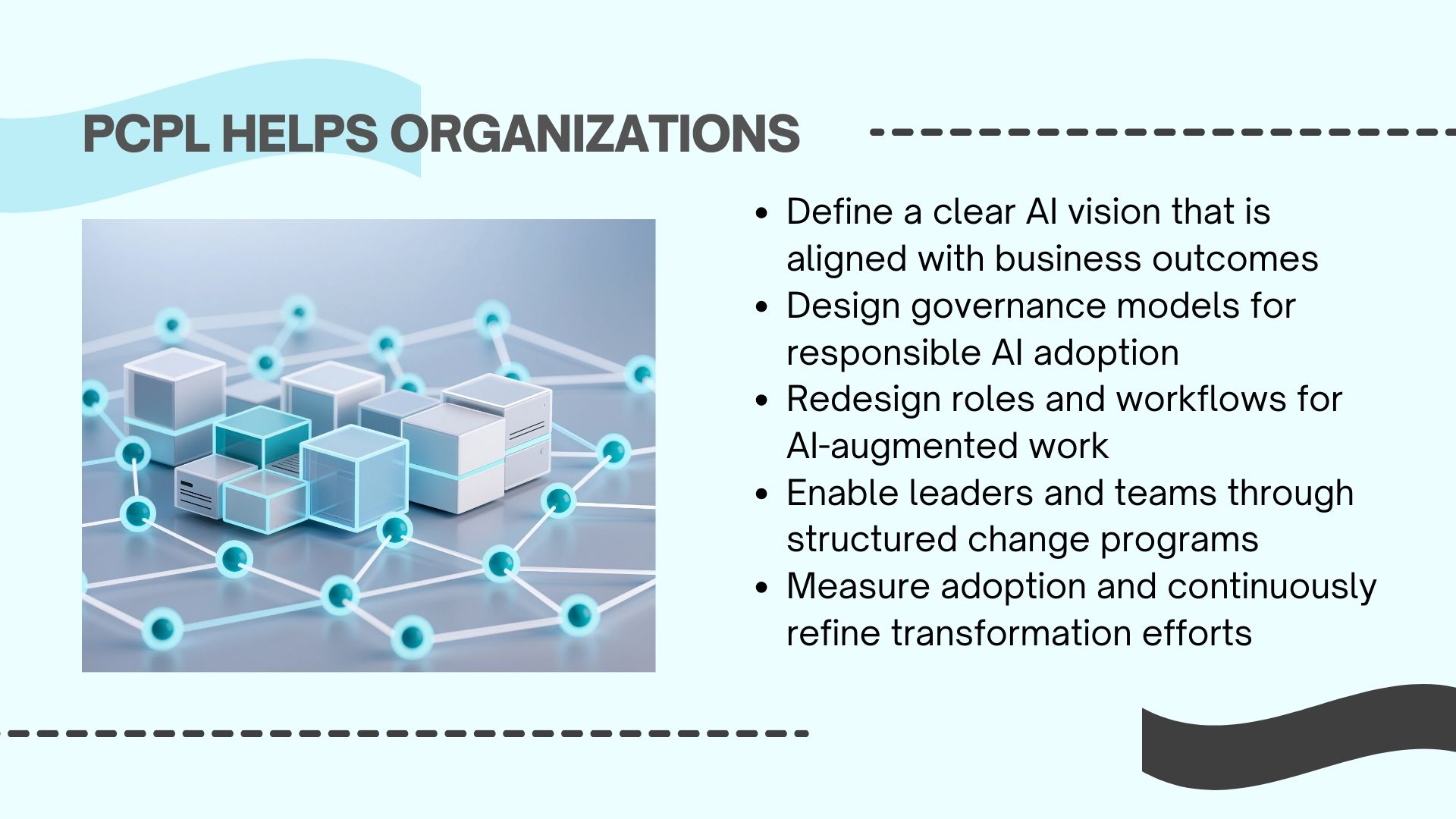
PCPL ensures that organizations do not just adopt AI, but embrace it confidently, responsibly, and sustainably, by placing people at the center of AI transformation.
Today AI is reshaping the workplace, and smooth change management is the difference between disruption and lasting value. PCPL is your trusted partner in making that transition successful.
References
https://www.blueprism.com/resources/blog/ai-change-management/
https://www.prosci.com/blog/8-ways-ai-driven-change-is-different