
IT consulting offers specialized expertise to help organizations refine their technology infrastructure and strategic approach.
IT consultants work in close collaboration with businesses to deliver tangible benefits like
- Enhanced Productivity
- Strengthened Security
- Driving Innovation
Reasons Organizations Need IT Consulting and MSPs
Businesses today require the support of IT consulting services and Managed Service Providers (MSPs) to successfully deal with the complexities of digital transformation and maintain a competitive advantage.
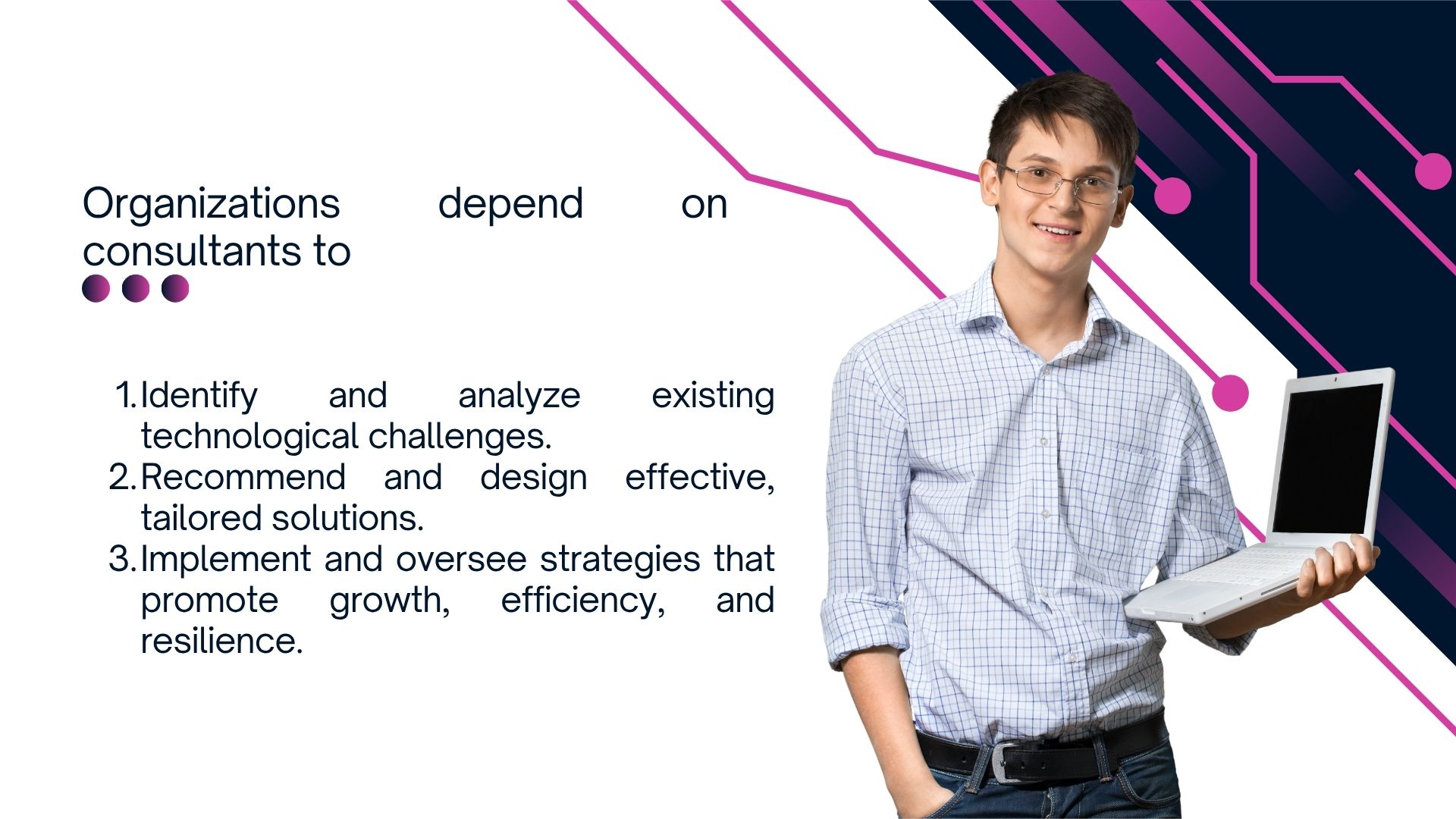
This strategic partnership allows companies to confidently use technology to achieve sustainable success while keeping their focus squarely on their core business goals.
Role of IT Consultants
An IT Consultant specializes in optimizing an organization’s technology infrastructure and systems to enhance business efficiency and prepare for digital growth.
Their work involves a systematic assessment of existing technological assets to identify gaps, vulnerabilities, or underperforming areas. Based on this thorough analysis, they provide expert recommendations for digital improvements and system-wide modifications that directly align with organizational targets. They handle everything from advisory planning, ensuring the proposed solution supports future scalability, to technical execution management, ensuring the implemented tools and systems resolve critical operational issues and deliver tangible results.
IT consultants are responsible for optimizing a company’s technology landscape. Their key duties involve assessing IT infrastructure, recommending tailored solutions, and developing strategic roadmaps. They oversee implementation, collaborating with teams and vendors, while rigorously ensuring security and compliance. A consultant’s work skillfully blends strategic planning (long-term direction and investment alignment) with technical execution (system implementation and issue resolution) to deliver goal-driven and effective operational outcomes.
Categories of IT Consulting Services
IT consulting services span a spectrum from strategic high-level planning to specialized areas like cloud environments, data intelligence, and security. These services collectively drive digital transformation, enhance operational efficiency, and manage risk for businesses of any scale.
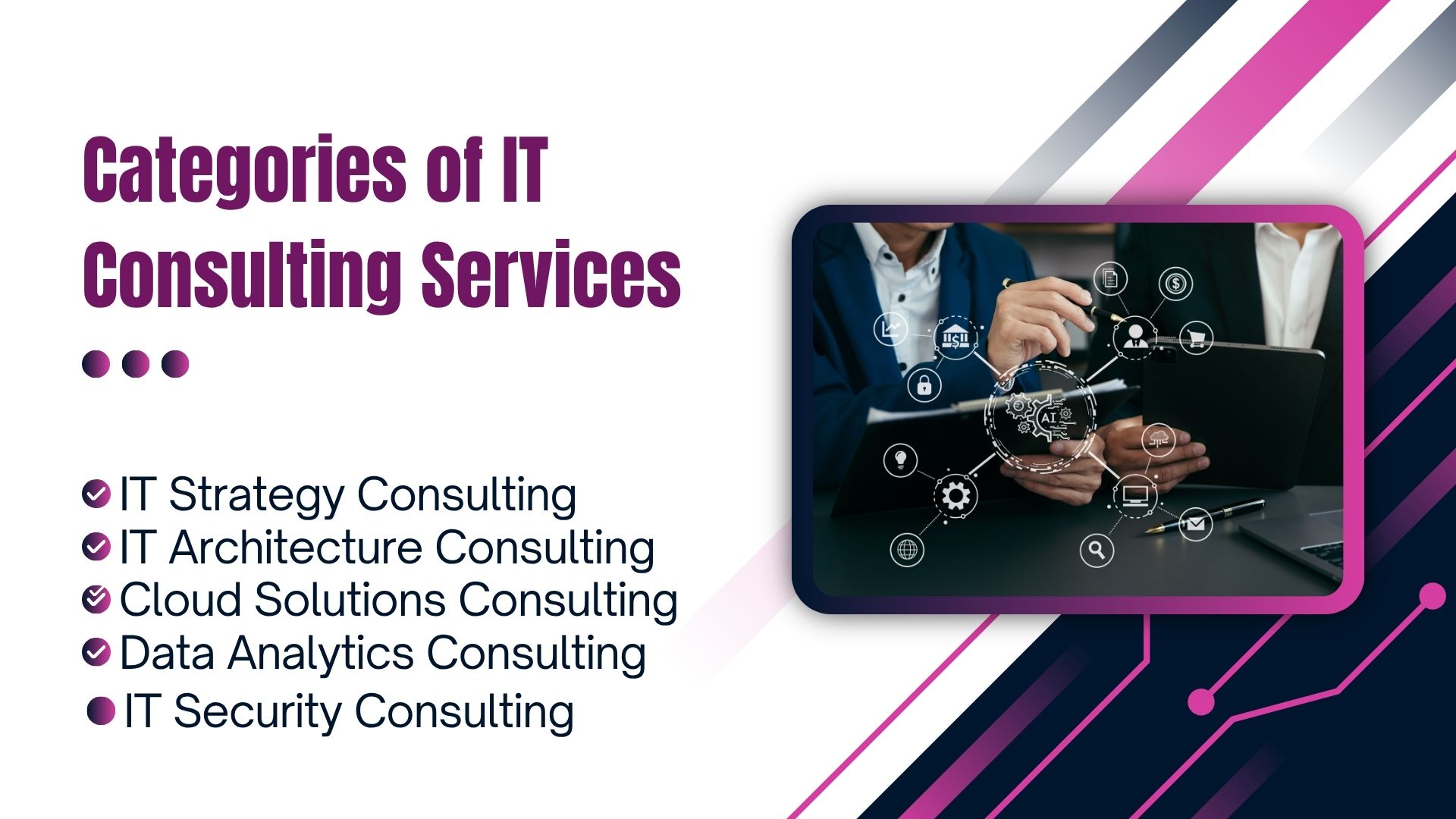
- IT Strategy Consulting
Aligning technology with core business goals and setting a unified direction for digital growth. They develop multi-year roadmaps, planning technology investments, and providing transformation oversight. They eliminate fragmented, short-term fixes and ensure resources are allocated effectively, improving governance. They help achieve a higher ROI, create unified operations, and build a future-ready IT framework that supports long-term scalability.
- IT Architecture Consulting
Designing the structural framework for how all technologies interact to ensure system scalability and stability. They design infrastructure layouts, developing integration models, and resolving system compatibility issues. They address issues like system incompatibility and platform sprawl, which cause system friction. This leads to a cohesive architecture that reduces friction, improves system uptime, and enables faster deployment of new technologies.
- Cloud Solutions Consulting
Planning and executing a secure, efficient transition to and optimization within cloud environments. They offer readiness assessments, migration planning, and design hybrid cloud architectures. They tackle challenges like high physical infrastructure costs and limits to operational scalability. They deliver flexible operations, remote accessibility, and potentially significant reductions (up to 50%) in IT overhead and costs post-migration.
- Data Analytics Consulting
Extracting clarity and actionable value from large volumes of raw, unstructured data. They build robust data pipelines, implement Business Intelligence (BI) platforms, and develop predictive models. They resolve issues related to siloed data, inconsistent KPIs, and unreliable business reporting. This enables real-time insights, improves decision speed and accuracy, and strengthens operational forecasting across business functions.
- IT Security Consulting
Protecting important systems and data by establishing robust defenses and ensuring compliance. They identify threats, conduct infrastructure audits, implement endpoint protection and Identity Access Management (IAM), and map regulatory compliance. They reduce risk exposure and help develop policies to prevent major security breaches. This significantly reduces vulnerability windows, strengthens stakeholder trust, and ensures the organization remains audit-ready.
Benefits of IT Consulting Services
IT consulting provides organizations with the strategic technological power they need to overcome challenges, optimize resources, and maintain a competitive advantage in today’s fast-paced digital landscape.

- Access to Expertise and Specialized Knowledge
IT consultants bring a deep, current understanding of emerging technologies, industry best practices, and complex systems. This expertise allows businesses to apply the right solutions efficiently, accelerating innovation while skillfully avoiding costly trial-and-error.
- Cost-Effective Technology Management
Leveraging external IT consulting is often more cost-effective than expanding internal teams. Businesses avoid the overhead of full-time salaries and ongoing training costs. Consultants optimize technology investments by identifying inefficiencies and recommending budget-friendly, high-impact solutions.
- Enhanced Security and Compliance
Consultants prioritize robust risk management and data protection. They implement strong cybersecurity measures and compliance frameworks, effectively protecting organizations from breaches, regulatory penalties, and safeguarding both reputation and customer trust.
- Improved Efficiency and Productivity
IT consultants analyze current workflows and implement automation tools to eliminate bottlenecks. This optimization streamlines processes, significantly reduces manual effort, and boosts overall employee productivity, leading to faster project delivery and operational excellence.
- Scalability and Flexibility for Growth
IT consulting is crucial for supporting business expansion. Consultants design technology infrastructures that are inherently scalable and adaptable. This ensures your systems can evolve seamlessly with market demands, allowing the company to expand without disruptive setbacks.
- Strategic IT Planning for Future Readiness
Consultants develop a clear IT roadmap that is tightly aligned with overarching business goals. This forward-looking approach helps organizations anticipate future challenges, align stakeholders, and make informed, sustainable decisions that drive long-term success.
- Reduced Downtime and Operational Resilience
Through proactive IT management, continuous monitoring, and rapid incident response, effective IT consulting minimizes system failures and downtime. This dedication to resilience ensures continuous operations, protects revenue streams, and maintains high customer satisfaction.
IT consulting can bring significant value, but businesses must be aware of and prepared for several potential drawbacks.
Probable Disadvantages of IT Consulting
The primary disadvantages relate to cost, security, integration, and internal dynamics.
- High Cost for Short-Term Engagements– Short-term projects often come with substantial fees that may not offer a clear long-term return on investment (ROI). This makes the investment potentially costly without sustained benefit.
- Data Security and Confidentiality Risks– Sharing sensitive business information with external consultants introduces a risk of data breaches or confidentiality lapses.
- Temporary Involvement– Consultants work for limited periods, which can result in a lack of sustained support or follow-through once the engagement ends, potentially leaving internal teams without critical continuity.
- Lack of Deep Internal Understanding– Consultants may not fully grasp the organization’s intricate culture, processes, or history. This can lead to proposed solutions that are less tailored or effective for the specific business context.
- Resistance from Internal Teams– Internal staff may view consultants as outsiders or threats, creating resistance that hinders collaboration, knowledge transfer, and overall project success.
When is the Right Time to Hire an IT Consulting Company?
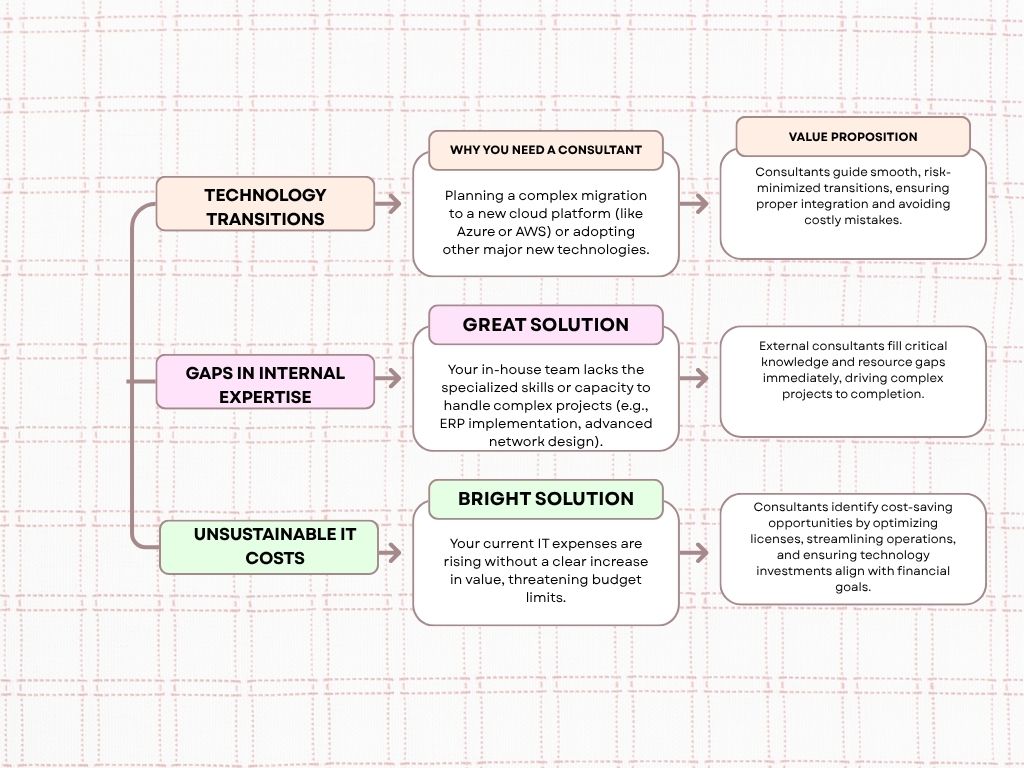
Hiring an IT consulting company is a strategic move that delivers maximum value when your business encounters specific, important challenges. Recognizing these “trigger points” ensures timely intervention, helping you maximize the return on investment from your chosen Managed Service Provider (MSP).
You should consider hiring an IT consulting firm when your organization faces any of the following six situations-

Skills an IT Consultant Should Master
An effective IT consultant requires a powerful blend of technical, business, and interpersonal skills to deliver solutions that drive business impact.
- Technical Proficiency– A deep and practical understanding of modern infrastructure, including hardware, software, networks, and cloud technologies (e.g., AWS, Azure, Google Cloud) to design and implement robust systems.
- Business Acumen– Insight into how technology directly influences business goals, market position, and operational efficiency.
- Analytical & Strategic Thinking– The ability to rapidly assess complex IT landscapes, diagnose root causes, and formulate strategic, long-term solutions rather than just fixing symptoms.
- Project Management & Execution– Proficiency in planning, coordinating, and delivering IT projects, ensuring they are completed on time, within budget, and meet defined objectives.
- Security Awareness & Compliance– Essential knowledge of cybersecurity principles, risk assessments, and industry-specific regulations (e.g., HIPAA, GDPR) to protect client data and infrastructure.
- Communication & Stakeholder Management– Strong verbal and written communication skills for clearly articulating technical concepts to both technical teams and non-technical business leaders and providing clear documentation.
- Adaptability & Continuous Learning– Flexibility to keep pace with the exponential speed of technological change and evolving client needs, demonstrating a commitment to mastering new platforms and tools.
Cost of IT Consulting Services
The cost of IT consulting services varies significantly, influenced by expertise, project scope, and industry specialization.
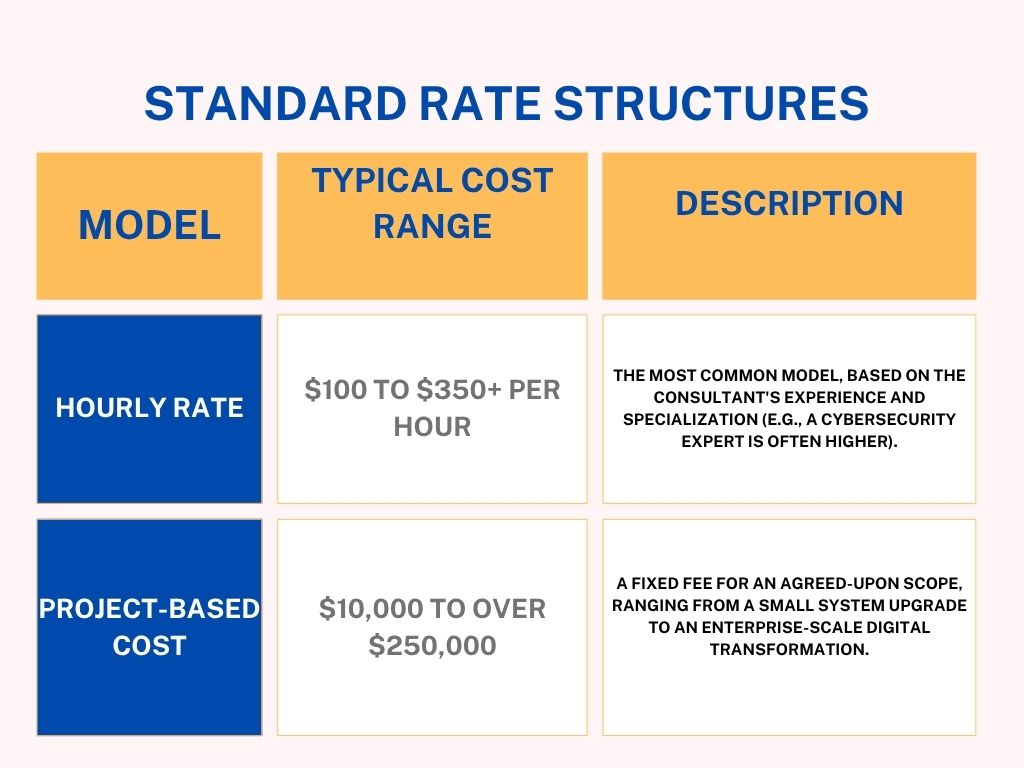
Factors Influencing Cost
- Consultant Experience- Highly experienced consultants or those with unique, in-demand skills command premium rates.
- Industry Specialization– Consulting in highly regulated sectors like finance, healthcare, or government typically incurs higher costs due to required regulatory compliance and expertise.
- Project Complexity– Projects involving multiple systems, high-risk security work, or bleeding-edge technology naturally cost more.
- Geographic Location– Rates can vary based on the firm’s location and whether on-site work is required (which may include additional travel and lodging fees).
- Hidden Costs– Businesses should also budget for potential additional costs like software licensing fees or extended support agreements after the initial deployment.
Choosing the Right IT Consulting Firm
Selecting the ideal IT consulting firm is crucial for ensuring technology initiatives are successful and aligned with strategic business goals.
1. Evaluate Expertise and Industry Fit
Look for proven experience in your specific industry (e.g., manufacturing, retail) and relevant technologies (e.g., cloud migration, ERP systems). A tailored approach means faster problem-solving and solutions that respect industry-specific regulations.
2. Verify Client Success and Reliability
Thoroughly review client testimonials, detailed case studies, and references. This validates the firm’s track record, outcome consistency, and ability to deliver results in real-world scenarios.
3. Assess Problem-Solving and Cultural Approach
Understand their project management methodology, communication practices, and how well their culture aligns with yours. Alignment ensures smoother collaboration, clear expectations, and outcomes that fit your company’s long-term vision.
4. Demand Scalability and Long-Term Partnership
Choose a firm that can offer scalable solutions and demonstrates a commitment to supporting your business through future growth or technological shifts. This maintains continuity, reduces vendor switching costs, and ensures adaptability.
5. Insist on Security and Compliance Standards
Prioritize firms with proven expertise in risk assessments, breach management, and relevant certifications (e.g., ISO 27001, SOC 2, HIPAA). A strong security posture is non-negotiable for protecting critical data and operations.
IT Consultants Drive Innovation and Efficiency
The future of IT consulting is fundamentally tied to the accelerating pace of digital transformation, revolving around Artificial Intelligence (AI), cloud computing, and advanced cybersecurity. IT consultants are no longer just troubleshooters but are strategic partners set to transform business efficiency and spur innovation. Managed Service Providers like PCPL are leading this charge by delivering advanced, tailored technology solutions that streamline operations and enhance competitiveness for businesses of all sizes.
As the digital era matures, consultants will be important in integrating emerging technologies, optimizing foundational infrastructure, and securing complex business environments.
Smarter Operations Through AI and Automation
IT consultants are implementing AI-powered solutions, such as Robotic Process Automation (RPA), intelligent chatbots, and predictive analytics, to automate repetitive tasks and optimize workflows. This strategy significantly reduces the potential for human error while accelerating processes in key areas like customer support, inventory management, and demand forecasting.
Businesses benefit from lower labor costs, faster turnaround times, and improved data accuracy, by enabling these smarter operations, which collectively boost productivity and empower staff to concentrate on high-value, innovative tasks.
Scalable Infrastructure with Cloud and Edge Support
A core focus for consultants is designing robust hybrid cloud and edge computing architectures. These allow for data processing closer to the end-user, drastically improving application responsiveness for modern demands like IoT devices, remote offices, and mobile workforces. They expertly guide businesses through complex cloud migration strategies, implementing scalable platforms like AWS, Azure, or Google Cloud that are meticulously tailored to specific operational needs.
This commitment to scalable infrastructure reduces downtime, cuts back on capital expenditures for physical hardware, and supports rapid, uninterrupted growth by allowing businesses to instantly provision resources on demand.
Proactive and Multi-Layered Security Planning
IT consultants are essential for conducting thorough risk assessments and implementing sophisticated, multi-layered security measures. This includes adopting zero-trust models, robust endpoint protection, and continuous monitoring systems. Furthermore, they ensure complete compliance with important industry standards, such as HIPAA, GDPR, or CMMC.
These proactive security plans are vital for reducing the risk of breach incidents, avoiding potentially devastating regulatory fines, and maintaining customer trust by safeguarding all sensitive data and critical business systems.
Turning Business Data into Strategic Decisions
Consultants are instrumental in transforming raw information into actionable strategic insights. They achieve this by developing powerful tools like data lakes, Business Intelligence (BI) dashboards, and specialized machine learning models. They empower businesses to analyze sales trends, customer behavior, and operational metrics in real-time.
This data-driven approach significantly improves forecasting accuracy, optimizes inventory and resource allocation, and enables highly personalized marketing strategies, ultimately leading to increased revenue and higher customer satisfaction.
IT Consultants Are A Necessity for All Business Sizes
The strategic value of an IT consultant applies universally.
Small businesses often lack the budget or in-house expertise for effective IT management. Consulting provides a cost-effective way to establish secure, efficient systems without the expense of a full-time IT department.
Mid-Sized companies benefit as they scale, requiring expert assistance to streamline operations, enhance infrastructure, and develop comprehensive future growth plans.
Large enterprises typically engage consultants for specialized, high-stakes needs such as complex cloud migration, strategic cybersecurity overhauls, or achieving nuanced regulatory compliance, where expert guidance ensures both accuracy and operational efficiency.
In the end, any business aiming to improve performance, reduce technology-related risk, or strategically align its technology with core business goals should consider expert IT consulting. PCPL provides highly tailored IT consulting services to businesses across the globe, ensuring each client can make confident, strategic technology decisions.
References
https://www.sterlingtechnolabs.com/blog/the-role-of-it-consulting-in-driving-innovation-growth